
A turnkey powder coating system is more than a collection of coating machines supplied by one manufacturer. Its value lies in how the equipment works together to meet production requirements, maintain coating quality and support a consistent manufacturing process.
For manufacturers planning a new coating line or upgrading existing equipment, the key question is not simply which machines to purchase. It is how pretreatment, conveying, powder application, powder recovery, curing and control systems should be configured to work as one coordinated production system.
Understanding these relationships helps manufacturers evaluate turnkey solutions more accurately and avoid paying for automation that does not address their actual production needs.
What Does a Turnkey Powder Coating System Include?
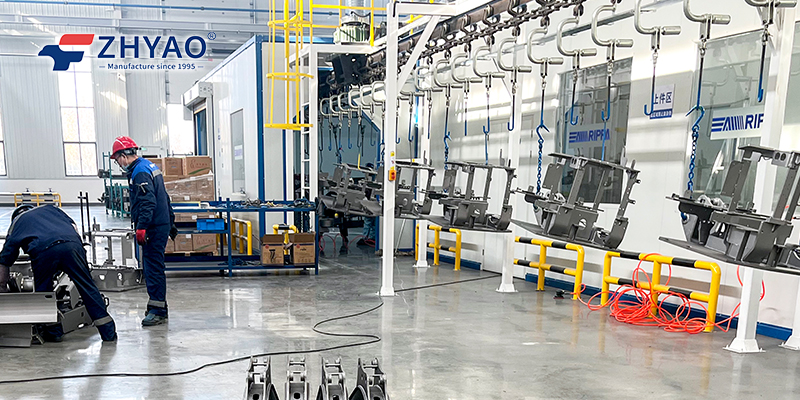
A turnkey powder coating system may include several interconnected stages, depending on the workpieces, coating requirements and project scope.
Pretreatment system: Removes contaminants and prepares the surface for coating. The required process depends on the substrate, surface condition and coating specification.
Conveyor system: Moves workpieces between process stages. Conveyor type, loading arrangement and speed affect production flow and the time available for each operation.
Powder coating booth and application equipment: Applies powder to the workpiece. Manual guns, automatic spray guns and reciprocators may be selected according to part geometry, production volume and required coating consistency.
Powder recovery system: Collects overspray where applicable and supports powder handling and reuse according to the system design and powder requirements.
Curing oven: Provides the thermal conditions needed for the powder coating to develop its specified properties. Oven capacity and effective heating time must match the workpieces and production schedule.
Electrical controls and system integration: Coordinate relevant equipment, conveyor movement, process settings and safety interlocks.
Not every turnkey project requires a completely new installation at every stage. Some manufacturers may already have suitable pretreatment equipment or curing ovens and only need to replace the application system or integrate additional automation.
The actual supply scope should therefore be defined around the customer's production requirements rather than a standard equipment list.
Why Equipment Integration Matters More Than the Number of Machines
A coating line can contain high-quality individual machines and still perform poorly if their operating capacities are not properly matched.
Consider a production line with automatic spray guns. If the conveyor delivers workpieces faster than the application system can coat them adequately, coating consistency may suffer. Conversely, an application system with more capacity than the production process requires may increase investment without delivering a meaningful improvement in output.
The same principle applies to the relationship between conveying and curing. Conveyor speed determines how long a workpiece remains in the curing oven. If the oven cannot provide the required time-temperature conditions at that speed, increasing upstream production capacity will not necessarily increase the number of properly cured parts.
Powder recovery also needs to suit the application process. The booth, extraction arrangement, recovery equipment and powder handling system must work together to maintain appropriate operating conditions.
These examples illustrate an important engineering principle: the production line should be designed around the capacity and requirements of the complete process, not the maximum capacity of individual machines.
How Much Automation Does Your Production Line Need?
A turnkey powder coating system does not have to be fully automatic to be effective. The appropriate automation level depends on the product mix, production volume, labor availability and frequency of changeovers.
Manual powder coating
Manual application can be suitable for lower production volumes, varied workpiece geometries or operations that require frequent adjustments by an operator. Initial equipment investment may be lower, but output and coating consistency can depend heavily on operator skill and working conditions.
Semi-automatic powder coating
Semi-automatic configurations can combine operator-controlled operations with automated conveying, powder application or other process functions. This approach may be appropriate when manufacturers want to improve consistency and throughput without automating every stage.
Fully automatic powder coating
Automatic spray guns, reciprocators and integrated conveying and control systems can reduce repetitive manual work and support more consistent application under suitable operating conditions. However, automatic equipment must be configured for the workpiece dimensions, geometry, loading pattern and coating requirements.
Complex parts may still require manual touch-up or supplementary operations. Frequent color changes may also influence the practical value of automation because cleaning, purging and setup can reduce productive time.
The best solution is therefore not necessarily the most automated one. It is the configuration that provides the required output and coating quality at an acceptable total operating cost.
Defining Project Scope Before Comparing Turnkey Quotes
Two suppliers may both offer a turnkey powder coating system while proposing substantially different equipment and responsibilities. Comparing their prices without checking the scope can lead to misleading conclusions.
Before evaluating quotations, manufacturers should clarify the following points:
Equipment supply: Which process stages, machines, conveyors and control systems are included?
Automation scope: Which operations are automatic, semi-automatic or manual? Are automatic spray guns, reciprocators and powder recovery systems included where required?
Production requirements: What workpiece dimensions, weights, product variations and target output must the system accommodate?
Installation and commissioning: Does the supplier provide installation, startup support, process adjustment and operator training?
Factory utilities and infrastructure: Who is responsible for electrical connections, compressed air, ventilation interfaces, foundations and other site-specific requirements?
Acceptance criteria: How will production capacity, coating quality, equipment operation and other agreed performance requirements be verified?
These details should be documented in the quotation and contract. The term “turnkey” alone does not establish that every building modification, utility connection or factory-side installation task is included.
A clear scope also makes it easier to compare suppliers on technical suitability, implementation responsibilities and long-term operating requirements rather than purchase price alone.
Designing the System Around the Workpiece and Production Process
The most effective turnkey powder coating projects begin with the parts that need to be coated and the production process they must follow.
Workpiece dimensions and weight influence conveyor selection, hanger design and oven loading. Part geometry affects spray gun positioning, coating accessibility and the potential need for manual touch-up. Production volume influences conveyor speed and application capacity, while the range and frequency of powder colors affect changeover procedures and recovery-system requirements.
These factors are interconnected. For example, increasing the size of a workpiece may require different hanger spacing, which can reduce the number of parts carried through the line at one time. If the target hourly output remains unchanged, the conveyor and application processes may need to be reconsidered.
This is why equipment selection should follow a coordinated review of workpieces, coating requirements, production targets and available factory space.
For manufacturers upgrading an existing line, the same principle applies. Before replacing equipment, it is worth identifying the actual bottleneck. If the main limitation is insufficient curing capacity, installing faster automatic spray guns alone will not resolve the overall production constraint.
FAQ
1. Does a turnkey powder coating system always include installation and commissioning?
Not necessarily. Installation, commissioning, training and factory-side utility work depend on the supplier's contractual scope. These responsibilities should be confirmed explicitly before an order is placed.
2. Is a fully automatic powder coating line always better than a semi-automatic system?
No. Fully automatic systems can benefit stable, repetitive production, but their investment and changeover requirements may not suit every operation. Semi-automatic systems can be more practical for varied workpieces, lower volumes or frequent product changes.