Automotive parts can vary significantly in size, geometry, material, and surface requirements. A powder coating system for these products therefore needs to be configured around the actual parts and production process rather than based on a standard equipment combination.
For automotive component manufacturers, the main challenge is usually not simply applying powder. It is achieving consistent coverage while maintaining production efficiency and adapting the system to the product range.
Automated Powder Spraying for Automotive Parts
Automatic powder spraying can provide more consistent coating conditions when parts are produced in repetitive volumes.
Automatic spray guns can maintain relatively stable spray positions and operating parameters, while reciprocators can move the guns to cover defined areas of the workpiece.
The appropriate configuration depends on the part geometry. Flat brackets, suspension components, housings, frames, and other automotive parts may require different gun positions and spray patterns.
Automation should therefore be based on the areas that need to be coated, production speed, and product variation rather than simply the number of spray guns.
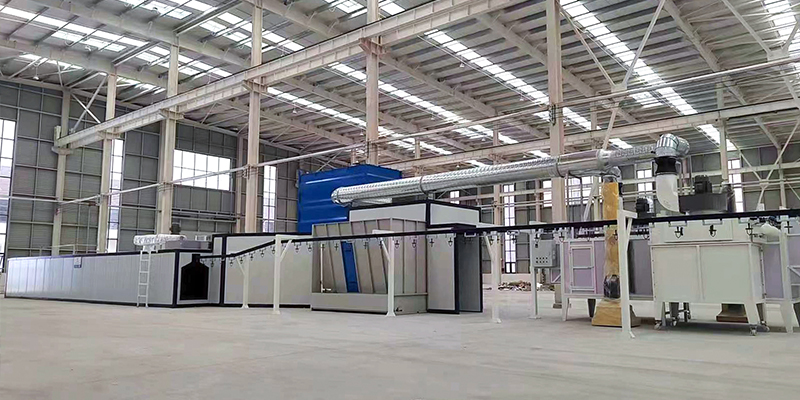
ZHYAO customized a powder coating line for automotive wheels for Yuanxiang Auto Parts in China. The system was designed according to the characteristics of wheel products and the customer's production requirements.
Handling Different Part Geometries
Automotive parts often contain corners, recesses, holes, and irregular surfaces. These features can affect powder coverage and require careful consideration during system design.
The position and orientation of the workpiece on the conveyor can influence the spraying distance and accessibility of different surfaces.
For some parts, automatic spraying can handle the main surfaces while manual touch-up is used for areas that are difficult to reach. For higher-volume production with relatively consistent products, a more automated spraying arrangement may be appropriate.
Conveyor and Hanger Configuration
The conveyor system determines how automotive parts move through the coating process.
Hanger design is particularly important when different parts are processed on the same line. The hanger must support the workpiece securely while providing suitable access for pretreatment, spraying, and curing.
Workpiece spacing also affects automatic spraying. If parts are positioned too closely, they can interfere with spray coverage and airflow. If spacing is excessive, available production capacity may not be fully utilized.
The conveyor, hanger, and spray system should therefore be designed together.
Powder Coating Booth and Recovery
The powder coating booth provides a controlled area for automatic spraying and overspray collection.
For automotive parts with frequent production changes or multiple powder colors, booth cleaning and color-change requirements become important considerations.
The recovery system should be selected according to production volume, powder usage, color-change frequency, and the intended handling of recovered powder.
A high-volume production line may require a different recovery arrangement from a line processing many colors in smaller batches.
Curing Requirements Depend on the Parts and Powder
After spraying, the coated parts enter the curing oven.
The curing process must follow the powder manufacturer's requirements and should be evaluated based on the actual temperature of the workpiece, not only the oven air temperature.
Part size, weight, material, loading density, conveyor speed, and heating capacity can all affect how the workpiece reaches the required curing condition.
This is particularly relevant when one line processes automotive parts with significantly different thermal loads.
Choosing the Right Level of Automation
Not every automotive parts manufacturer needs the same degree of automation.
A production line handling high volumes of similar parts may benefit from automatic spray guns, reciprocators, automatic conveying, and integrated powder recovery.
A factory producing many different parts in smaller batches may need more flexibility and easier changeover. In some cases, combining automatic spraying with manual touch-up is more practical than attempting to automate every operation.
The right automation level depends on production volume, product variety, labor requirements, and the expected future production mix.
What Should Be Considered Before Designing the System?
Before configuring a powder coating system for automotive parts, the following information should be defined:
Workpiece dimensions and weight
Part geometry and surfaces to be coated
Material and surface condition
Required coating and finish
Production capacity
Product variety
Powder colors and change frequency
Conveyor speed and loading method
Desired automation level
Available factory space
These factors determine how the automatic spraying, conveyor, booth, recovery, and curing systems should be configured.
A powder coating system for automotive parts should be designed around the actual production conditions. The objective is not simply to automate more equipment, but to achieve suitable coating coverage, stable production, and the flexibility required by the product range.
FAQ
Can the same powder coating system handle different automotive parts?
Yes, if the parts are within the designed size, weight, geometry, and production range. However, different parts may require changes to hanger configuration, spray gun positioning, conveyor loading, or operating parameters.
When is automatic powder coating suitable for automotive parts?
Automatic powder coating is particularly suitable when production volumes are repetitive and consistent coating coverage is required. For highly variable products or smaller batches, a combination of automatic spraying and manual touch-up may provide greater flexibility.