
Investing in powder coating automation is not simply a matter of replacing manual spraying with automatic equipment. The real value depends on how well the automated components work together and whether the system improves the factory's actual production performance.
An automatic spray gun may increase spraying consistency, but it will not necessarily increase finished output if the curing oven is already the production bottleneck.
Similarly, a robotic spraying system may offer greater flexibility, but its investment value depends on product variety, programming requirements, and how frequently the equipment is used.
A sound investment analysis should therefore evaluate the complete production process rather than the performance of individual machines.
1. Identify Where Automation Can Create Measurable Value
Before selecting equipment, determine which production problems the investment is expected to solve.
Common reasons for considering powder coating automation include excessive manual spraying work, inconsistent coating coverage, insufficient production capacity, high rework rates, and difficulty maintaining stable output across shifts.
However, these problems require different solutions.
If operators spend most of their time repeatedly spraying similar workpieces, automatic spray guns and reciprocators may reduce repetitive manual work.
If complex workpiece geometry makes consistent coverage difficult, a robotic system or a combination of automatic and manual spraying may be more appropriate.
If production delays mainly occur during loading, unloading, or material transfer, improvements to the conveyor system may deliver more value than upgrading the spraying equipment.
The first investment decision should be based on the location and cause of the existing bottleneck. Automating an operation that is not limiting production may improve that operation without significantly increasing the number of finished parts.
2. Evaluate the Cost of the Complete Automation System
The purchase price of an automatic spray gun or robot does not represent the total investment required to automate a powder coating process.
Depending on the project, the investment may include:
- Automatic spray guns, reciprocators, or robotic spraying equipment.
- Powder coating booths and powder recovery systems.
- Conveyors, workpiece positioning equipment, and loading arrangements.
- Pretreatment and drying equipment where required.
- Curing ovens and associated temperature control systems.
- Electrical controls, sensors, safety equipment, and system integration.
- Installation, commissioning, operator training, and initial production testing.
Not every project requires all these components to be replaced. An existing line may be suitable for a targeted upgrade, while a new production facility may require a complete integrated system.
The important distinction is between the cost of an individual machine and the cost of achieving the intended production result.
For example, installing automatic spray guns in an existing booth may require modifications to gun positioning, conveyor spacing, or controls.
If these integration requirements are overlooked during budgeting, the initial equipment quotation may substantially understate the actual investment.
A complete evaluation should establish the project scope and identify which existing equipment can be reused without compromising production requirements.
3. Match Automation Capacity Across the Entire Line
One of the most important investment considerations is whether the automated equipment has compatible production capacity.
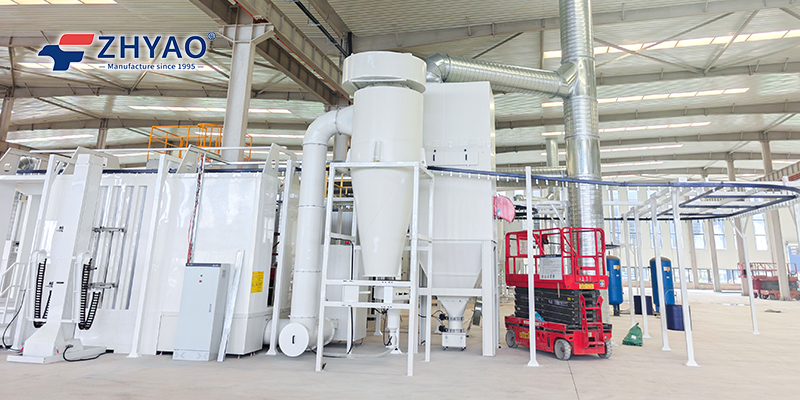
A powder coating line typically involves workpiece handling, pretreatment, drying, spraying, powder recovery, curing, and coordinated material movement. The exact configuration varies by application.
If these stages cannot support a common production rate, the line's finished output will be constrained by its limiting operation.
Consider a factory that installs a high-capacity automatic spraying system but retains a curing oven that cannot accommodate the required throughput. The spraying system may have unused capacity because the oven cannot process workpieces quickly enough.
The opposite can also occur. A high-capacity curing oven may remain underutilized if the spraying process cannot supply enough coated workpieces.
Automation investment should therefore consider:
- The required finished output under realistic operating conditions.
- The processing time and capacity of each critical stage.
- Workpiece dimensions, weight, and hanging arrangements.
- Conveyor speed and the required curing schedule.
- Loading patterns, changeovers, and expected downtime.
- The capacity needed to accommodate the actual product mix.
The goal is not to maximize every machine's individual capacity. It is to create a balanced system that meets the required production target without unnecessary investment in equipment that cannot be fully utilized.
4. Choose the Right Automation Technology for the Product Mix
Different automated spraying technologies serve different production requirements. Choosing the most sophisticated option does not automatically produce the best financial result.
Automatic spray guns and reciprocators
These systems are often suitable for repetitive production involving workpieces with relatively consistent dimensions and hanging positions. They can repeat established spraying movements and reduce the amount of manual spraying required.
Their investment value depends on how consistently the factory produces compatible workpieces and whether the equipment can achieve the required coverage.
Robotic powder coating systems
Robots offer programmable movement and greater flexibility in spray angles and paths. They may be appropriate for complex geometries, varied surface orientations, or applications where conventional reciprocators cannot provide the required access.
However, robotic systems also involve programming, integration, maintenance, and process setup. Frequent product changes may increase the time and effort required to maintain efficient operation.
Integrated conveyor and control systems
Automation can also improve production flow by coordinating workpiece movement, spraying operations, and other process stages. Accumulation or controlled-release conveying may be useful where different operations require different operating rhythms.
The benefit depends on the actual process layout and how the system responds to interruptions. More complex controls do not eliminate bottlenecks automatically.
In some factories, combining reciprocators for routine surfaces with manual touch-up or robotic spraying for difficult areas may provide a better balance of investment and flexibility than using robots for every spraying task.
5. Account for Utilization, Changeovers and Maintenance
An automated system creates value only when it is used effectively.
A factory with stable, high-volume production may spread its fixed investment across a large number of workpieces. A factory with irregular orders, frequent color changes, or long periods of idle time may achieve much lower utilization.
Color changes deserve particular attention in powder coating. When frequent changes require booth cleaning, equipment cleaning, or recovery-system adjustments, the associated downtime can reduce productive capacity.
The time required depends on the booth and recovery design, powder colors, cleaning procedures, and production organization.
Maintenance is another important consideration. Automatic spray equipment, robots, conveyors, sensors, and control systems require appropriate inspection and servicing.
Spare parts availability, technical support, operator training, and recovery procedures can affect how quickly production resumes after a failure.
A realistic investment assessment should therefore use expected productive hours rather than assuming the line will operate continuously at its rated capacity.
6. Calculate the Financial Return Using Factory Data
The financial case for powder coating automation should be based on the costs it can realistically reduce and the additional production value it can deliver.
Relevant benefits may include lower direct spraying labor requirements, reduced rework, more consistent production, improved throughput, and better use of available production hours.
Potential additional costs include financing, maintenance, electricity, compressed air, consumables, training, and system downtime. Powder consumption should also be evaluated, but savings must not be assumed solely because a line is automated.
Transfer efficiency and powder recovery depend on equipment design, workpiece geometry, powder characteristics, and operating practices.
A straightforward payback calculation can help establish whether the investment deserves further consideration.
Annual net benefit = Annual operating cost savings + Additional contribution from saleable production − Additional annual operating costs
Simple payback period = Initial investment ÷ Annual net benefit
For this calculation, additional contribution should reflect the actual economic value of extra saleable output, not simply its sales revenue.
The analysis should also avoid counting the same benefit twice, such as treating reduced labor costs and the full value of the same labor-related output improvement as independent savings when they overlap.
For example, if a proposed system costs $200,000 and produces a verified annual net benefit of $50,000, its simple payback period would be four years.
This is an illustrative calculation, not a forecast for a typical powder coating project. Actual results depend on labor costs, utilization, production demand, maintenance, energy consumption, and the value of additional saleable output.
Simple payback is also not a complete investment measure. For projects with substantial ongoing costs or long operating lives, discounted cash flow and net present value can provide a more comprehensive comparison.
7. Design for Future Expansion Without Buying Unused Capacity
Production requirements can change after installation. New products, larger workpieces, increased order volumes, or different coating specifications may create new demands on the system.
However, buying the maximum possible automation capacity at the beginning may increase investment without delivering an immediate benefit.
A more practical approach is to identify which design decisions are difficult to change later and which can be upgraded when demand justifies the cost.
For example, conveyor routing, oven layout, building dimensions, and the arrangement of major process stages may be expensive to modify after installation. Planning these elements around credible future requirements can preserve expansion options.
By contrast, some spraying equipment, controls, or automation functions may be added or upgraded later, provided the original system has sufficient compatibility and capacity.
Future expansion should be planned around realistic production forecasts, not an undefined expectation that output will eventually increase.
Conclusion
The value of powder coating automation depends on more than equipment price, rated capacity, or the number of automated operations.
It depends on whether the selected technology addresses a genuine production limitation and whether the complete system can operate efficiently under actual factory conditions.
Before investing, define the expected production improvements, assess the capacity of every critical process stage, account for changeovers and maintenance, and calculate the financial return using realistic operating data.
A well-matched automation system may deliver greater long-term value than a more expensive configuration with unused capacity or poorly integrated equipment.
FAQ
1. Which powder coating equipment should be automated first?
Start by identifying the operation that most restricts finished output, coating consistency, or labor efficiency.
Automatic spray guns may be suitable for repetitive spraying, robots may help with complex geometries, and conveyor improvements may be more valuable when material handling is the main bottleneck.
2. Is a robotic powder coating system always more cost-effective than automatic spray guns?
No. Robots offer greater path flexibility, but they also involve programming, integration, and maintenance requirements. Automatic spray guns with reciprocators may be more economical for stable production involving similar workpieces.
The appropriate choice depends on product geometry, production volume, changeover frequency, and required coating coverage.
SEO Title: Powder Coating Automation Investment: Costs and ROI