A custom automated powder coating line should be designed around the actual production process rather than a fixed equipment package.
Workpiece characteristics, production capacity, product variety, coating requirements, factory space, and the required level of automation all influence the final configuration.
Start With the Workpieces
The first step is to define what the line will actually coat.
Important information includes:
- Maximum and minimum workpiece dimensions
- Workpiece weight
- Shape and surface geometry
- Material and surface condition
- Required coating areas
- Product variety
Workpiece geometry affects hanger design, conveyor spacing, spray gun arrangement, and access to difficult-to-coat areas.
Define the Production Target
Production capacity determines how the line needs to operate.
Instead of looking only at annual output, consider the required output per hour or shift, loading frequency, product mix, batch size, and production schedule.
These factors influence conveyor speed, hanger spacing, oven capacity, spraying configuration, and whether accumulation or buffering is needed.
Choose the Right Automation Level
Not every production line needs the same level of automation.
For stable, high-volume production, automatic powder spray guns, reciprocators, automatic conveying, and other automated systems can reduce repetitive manual work and improve production consistency.
For products with frequent size changes or complex geometries, a combination of automatic spraying and manual touch-up may be more practical.
The goal is not to maximize the number of automated machines. It is to automate the operations where automation provides a practical production benefit.
Design the Conveyor Around the Process
The conveyor connects the major stages of the coating system and needs to be designed together with the rest of the line.
Workpiece weight, hanger design, spacing, conveyor speed, production capacity, and factory layout all affect the conveyor configuration.
For mixed production or changing workloads, accumulation sections can also provide additional flexibility between process stages.
Match the Spraying System to Product Geometry
Automatic spraying equipment should be selected according to the shape and size of the workpieces.
The number and position of automatic spray guns, reciprocator movement, spray coverage, conveyor speed, and required film thickness need to work together.
Complex parts may contain recessed areas, corners, or surfaces that are difficult for fixed automatic guns to reach. In these cases, manual spraying can be integrated into the system rather than forcing the entire process to be fully automatic.
Size the Curing System With the Production Line
The curing oven should be designed according to workpiece dimensions, loading arrangement, conveyor speed, thermal load, and the curing requirements of the selected powder.
Conveyor speed and curing time must be considered together to ensure that the workpieces reach the required curing conditions at the planned production rate.
Plan Powder Recovery and Color Management
Powder recovery requirements depend on production volume, powder consumption, product mix, and color-change frequency.
Long production runs with limited color changes may use a recovery system designed for continuous operation. Frequent color changes place greater emphasis on booth cleaning, powder separation, and changeover time.
The recovery system should therefore be matched to the actual production schedule rather than selected only according to powder consumption.
Fit the System Into the Factory
A custom line must also work within the available building.
Before finalizing the design, consider:
- Workshop length, width, and height
- Existing columns and structures
- Loading and unloading locations
- Material flow
- Power and heating requirements
- Maintenance access
- Space for future expansion
A suitable equipment configuration can still create operational problems if material flow or maintenance space is poorly planned.
Design the Line as One System
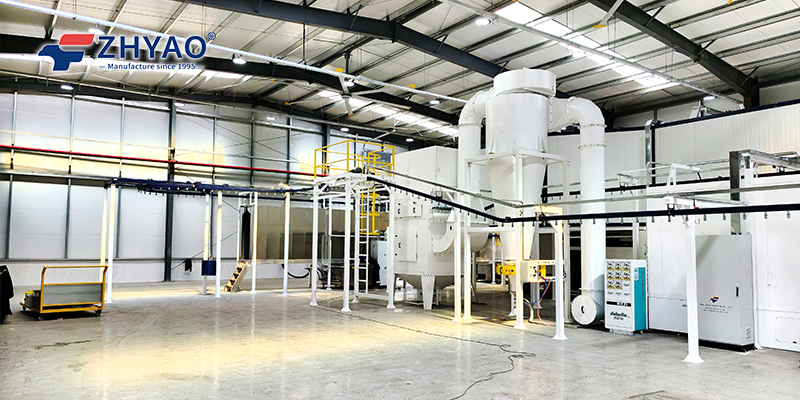
A custom automated powder coating line is not simply a combination of a conveyor, spray booth, automatic guns, recovery system, and curing oven.
These systems need to work together.
For example, increasing production capacity may require a higher conveyor speed, which can affect hanger spacing, spray coverage, oven residence time, and loading efficiency.
Changing workpiece size may also require changes to the hanger, conveyor, spray arrangement, and oven dimensions.
The design should therefore start with the production requirements and then determine the equipment configuration.
What Information Is Needed for a Custom Design?
Before developing a powder coating line proposal, provide:
- Workpiece dimensions and weight
- Product drawings or photos
- Required production capacity
- Product variety
- Number of coating colors
- Coating requirements
- Available factory space
- Preferred heating source, if applicable
- Desired automation level
The more accurately these conditions are defined, the easier it is to develop a line configuration that matches the actual production process.
FAQ
Can one automated powder coating line handle different products?
Yes, provided the products fall within the designed range of dimensions, weight, hanger configuration, spraying coverage, curing requirements, and production capacity. Mixed products may also require a combination of automatic and manual spraying.
Does a custom powder coating line always need to be fully automatic?
No. The appropriate automation level depends on production volume, product consistency, geometry, labor requirements, and investment objectives.
A partially automated system can be suitable when products vary significantly or certain coating operations still require manual intervention.