Metal parts can range from small brackets and hardware to welded machine components, electrical enclosures, frames, and irregular assemblies. Although these products may all use powder coating, they do not necessarily require the same production system.
For a factory planning a new coating line or upgrading an existing one, the practical question is not simply which equipment is better. The more useful question is: how should the coating system be configured around the actual parts, production volume, and required flexibility?
Start With the Parts, Not the Machines
Before selecting automatic guns, conveyors, or ovens, the production team should define the range of workpieces.
Important information includes:
- Maximum and minimum part dimensions
- Part weight
- Material type
- Part geometry
- Open, flat, tubular, or recessed surfaces
- Required coating areas
- Production quantity
- Product variety
- Number of colors
- Required coating quality
These factors interact with each other.
For example, a factory producing a large quantity of similar brackets can use a highly repeatable automatic spraying arrangement. A manufacturer producing different machine components in small batches may benefit more from a flexible system with manual touch-up capability.
The configuration should therefore be built around the production pattern rather than around a fixed equipment package.
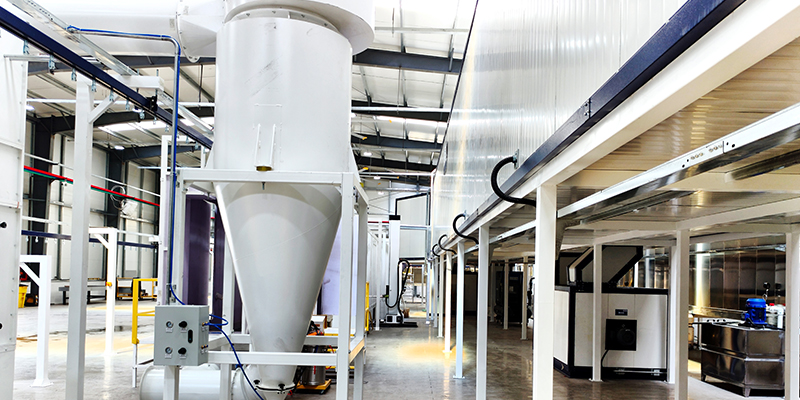
(ZHYAO automatic spraying production line under installation in Mongolia.)
Choose the Pretreatment Method According to the Metal Parts
Surface preparation should be selected according to the material and condition of the workpieces.
Steel parts with oil, rust, scale, or welding residues may require a different preparation method from relatively clean aluminum or fabricated sheet-metal components.
Depending on the project, pretreatment may use:
- Spray pretreatment
- Immersion pretreatment
- Shot blasting
- A combination of different preparation methods
The choice also depends on production volume, part geometry, required surface performance, available space, and environmental requirements.
For example, complex parts with internal areas may be difficult to treat uniformly with a simple spray arrangement, while mechanical preparation may be more appropriate for certain steel components with rust or scale.
The goal is not to install the largest pretreatment system available. It is to provide a surface condition that is suitable for the selected coating process.
Match Powder Application to Product Geometry
The powder application section is usually where the biggest difference between a basic and highly automated configuration becomes visible.
Automatic powder guns are well suited to parts with relatively consistent dimensions and repeatable hanging positions. Reciprocators can move guns through a defined stroke to cover the required vertical area.
However, automation does not automatically solve difficult geometry.
Recesses, corners, narrow gaps, deep channels, and surfaces shielded by other sections of the workpiece may require different spray angles or additional manual application.
For this reason, a combination of automatic and manual spraying can be practical for factories producing mixed metal parts.
Automatic guns handle repeatable surfaces, while operators can reinforce areas that are difficult to reach.
This approach can provide more flexibility than trying to make every product fit the same automatic spray pattern.
The Number of Automatic Guns Should Be Calculated
More spray guns do not necessarily mean a better coating system.
The required number and arrangement of automatic guns depend on:
- Part height and width
- Part geometry
- Conveyor speed
- Gun spray pattern
- Reciprocator stroke
- Required film thickness
- Production volume
- Part spacing
- Areas that require manual touch-up
If the workpiece is positioned inconsistently, adding more guns may not solve the underlying problem.
A repeatable hanger position, appropriate gun distance, suitable spray pattern, and coordinated conveyor movement are often more important than simply increasing gun quantity.
Design the Hanger Around the Coating Process
Hangers are easy to overlook during equipment selection, but they directly affect how metal parts move through the line.
A suitable hanger needs to support the workpiece securely while maintaining the required orientation during pretreatment, powder spraying, and curing.
For different products, the hanger design may need to consider:
- Part weight
- Center of gravity
- Contact points
- Drainage after wet pretreatment
- Spray access
- Oven airflow
- Electrical grounding
- Spacing between adjacent parts
If a part rotates, tilts, or blocks another part during production, the problem may appear to be a spray-system issue when the actual cause is the way the workpiece is presented.
For factories handling several product families, interchangeable or product-specific hanging fixtures can provide useful flexibility.
select the Conveyor for Production Rhythm
The conveyor should be designed according to the required production rhythm rather than selected independently.
For example, the relationship can be considered as:
Required output → hanger loading → carrier spacing → conveyor speed → spraying time → curing time
If a factory needs higher output, simply increasing conveyor speed may not be sufficient. The pretreatment process, spray coverage, and curing capacity must all support the new production rate.
For factories with relatively stable products and continuous production, a conventional conveyor arrangement may be adequate.
Where production includes mixed parts, temporary interruptions, or changing workloads, an accumulation conveyor can provide additional buffer capacity.
The key is to use accumulation where it solves a real production-flow problem rather than adding it simply because it is a more advanced conveyor configuration. Existing content on this site has already covered the difference between continuous and accumulation conveyor systems; for this topic, the focus should remain on how conveyor choice fits the overall metal-parts configuration.
Size the Curing Oven Around the Actual Workpieces
The curing oven should be matched to the selected powder, workpiece characteristics, conveyor speed, and required cure schedule.
The important parameter is not simply the oven's air temperature. The workpiece itself must reach the temperature and receive the time required by the powder manufacturer's curing specification.
Large or heavy metal parts may heat differently from small thin components. This means that a configuration designed around small parts should not automatically be applied to heavier assemblies.
The oven therefore needs to be considered together with:
- Maximum workpiece dimensions
- Part weight and thermal mass
- Conveyor speed
- Loading density
- Required cure schedule
- Air circulation
- Heating capacity
This is one reason why increasing production speed can require changes elsewhere in the line rather than simply adjusting the conveyor.
Powder Recovery Should Match Production and Color Changes
Powder recovery is another area where configuration should follow the production pattern.
For long production runs with relatively stable colors, a recovery system designed for continuous operation can be useful.
For factories changing colors frequently, cleaning time and powder separation may become more important. In this situation, a recovery configuration that is easy to clean and manage may be more practical than simply maximizing recovery capacity.
The best recovery arrangement therefore depends on both powder consumption and production scheduling.
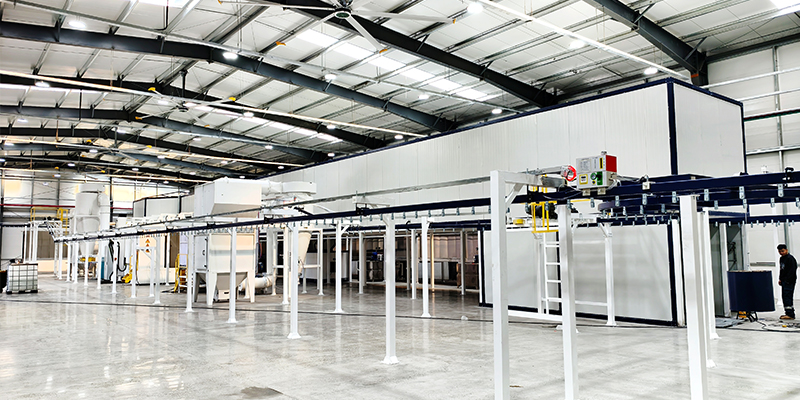
Automation Level Should Follow Product Repeatability
Not every metal-parts factory needs the same level of automation.
A useful way to think about the configuration is:
High-volume + repeatable parts → higher automation potential
Mixed products + frequent changes → greater need for flexibility
Complex geometry → automatic spraying combined with manual touch-up may be appropriate
Small batches → a simpler configuration may provide better operational flexibility
Automation is most useful when the production conditions are repeatable enough for the system to reproduce the same process consistently.
If product dimensions, hanging positions, colors, and production schedules change constantly, excessive automation can make the system more complicated without delivering a proportional benefit.
What a Practical Metal Parts Coating Configuration May Look Like
For a factory producing medium- to high-volume metal parts with reasonably repeatable products, a typical configuration may include:
Loading → Pretreatment → Drying → Automatic Powder Booth → Manual Touch-Up → Powder Recovery → Curing Oven → Cooling → Unloading
The exact arrangement can then be adjusted according to the application.
For example:
- Stable high-volume parts: more automatic spraying and automated part handling may be justified.
- Mixed metal components: automatic guns plus manual touch-up can provide a balance between productivity and flexibility.
- Heavy welded parts: stronger hanging and conveying arrangements may become more important.
- Frequent color changes: booth cleaning and powder management should receive greater attention.
- Complex parts: gun positioning, part orientation, and manual reinforcement may be more important than simply increasing gun quantity.
This is why two factories producing “metal parts” can require very different coating systems.
The Best Configuration Is the One That Fits the Production Conditions
There is no universal best configuration for metal parts coating.
A practical system should connect five decisions:
Workpiece characteristics → surface preparation → handling and hanging → powder application → curing and production flow
Automation, powder recovery, conveyor type, and control systems should then be added according to the actual production requirements.
For factory owners and purchasing teams, this approach also makes supplier quotations easier to compare. Instead of comparing only the number of guns, oven size, or conveyor length, the more useful comparison is whether each proposed system actually matches the products, output, production mix, and future operating conditions.
For technical engineers, the same principle helps prevent equipment from being selected independently. A change in workpiece size or production rate can affect the conveyor, hanger, spray arrangement, oven, and even powder recovery requirements.
The right configuration is therefore not the one with the most equipment. It is the one in which the major systems work together around the products the factory actually needs to coat.
FAQ
Can one powder coating system handle different types of metal parts?
Yes, if the parts fall within the designed range of dimensions, weight, geometry, hanging method, and coating requirements. For mixed production, automatic spraying can be combined with manual touch-up, and different hanger designs can be used for different product families.
How do I know whether my metal parts need an automatic powder coating system?
Consider production volume, product repeatability, labor requirements, coating consistency, and product variety together. High-volume production with stable part geometry generally provides more opportunities for automation, while low-volume or highly variable production may require a more flexible configuration.