The right automation level depends on more than production volume. Product variety, workpiece geometry, coating requirements, color changes, labor availability, and future production plans all affect how much of a powder coating line should be automated.
Start With the Production Pattern
A factory producing a small number of standardized products has different automation needs from a factory handling many product types.
High-volume production with relatively consistent workpieces is generally easier to automate because the spraying path, hanger arrangement, conveyor movement, and process conditions can remain relatively stable.
When products change frequently, more manual intervention may still be useful, particularly for loading, unloading, touch-up, or areas that are difficult for automatic guns to reach.
The goal is not to automate every operation, but to automate the operations that can remain stable and repeatable.
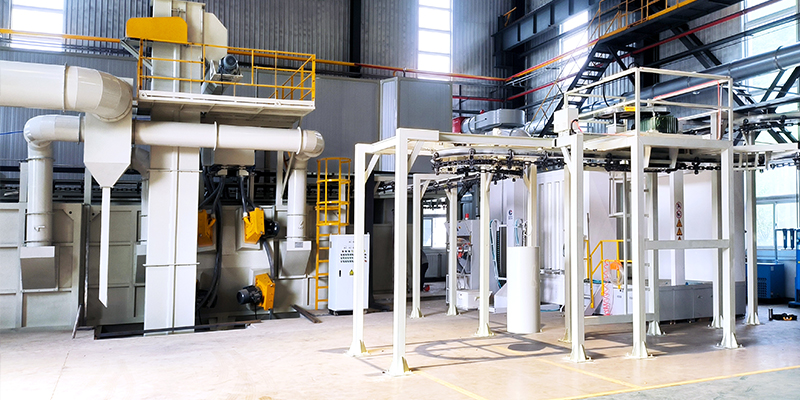
(Baoji Group Plug-in Backing Plate Powder Coating Line)
Manual, Semi-Automatic, or Fully Automatic?
A manual line provides flexibility and is often suitable when product variety is high or production volume is limited.
A semi-automatic system can combine automatic spraying with manual loading, unloading, or touch-up. This configuration can be practical when the main coating surfaces are suitable for automatic application but some parts of the process still require operator judgment.
A more highly automated line can integrate automatic powder guns, reciprocators or robots, automatic conveyor control, powder recovery, and other automated functions. It is more suitable when production requires consistent operation over long periods.
The appropriate level depends on the production process rather than the automation level itself.
Workpiece Shape Determines How Much Can Be Automated
Workpiece geometry is one of the most important factors.
Flat panels, regular frames, profiles, and other relatively consistent products can often be handled efficiently by automatic spray equipment.
Deep recesses, complex structures, narrow gaps, or irregular surfaces may require additional spray angles, different gun arrangements, reciprocator movement, robotic programming, or manual touch-up.
For this reason, production volume alone should not determine the automation level.
Product Variety Affects Automation Flexibility
A factory producing many different products needs to consider how quickly the system can adapt.
Different workpiece dimensions may require different hanger arrangements, spray distances, gun positions, conveyor spacing, or spraying programs.
If product changes are frequent, automation should be designed with sufficient flexibility. Otherwise, excessive automation can make changeovers more complicated instead of improving production efficiency.
This is particularly relevant for factories serving multiple product lines rather than producing one standardized product.
Powder Color Changes Also Matter
Color change requirements can influence the automation configuration.
If a factory runs one or two colors for long production batches, an automatic powder system can operate with relatively few interruptions.
Frequent color changes require more attention to powder recovery, booth cleaning, powder supply, and changeover procedures. Automatic color-change systems can reduce manual work, but their value depends on the actual production schedule.
The number of colors is therefore less important than how frequently those colors are changed.
Choose Automation by Process, Not by Equipment Name
A common mistake is deciding to “buy an automatic powder coating line” before determining which operations actually need automation.
A better approach is to divide the production process into individual operations:
- Loading and unloading
- Workpiece conveying
- Automatic powder spraying
- Manual touch-up
- Powder recovery
- Color change
- Curing
- Process monitoring
Each operation can then be evaluated according to its repeatability, labor requirement, production volume, and technical difficulty.
This often leads to a mixed configuration rather than an all-or-nothing automation solution.
Consider Future Production Changes
Automation should also be considered in relation to future production.
If product volume is expected to increase, the initial system may need enough capacity for additional automatic guns, reciprocators, robots, conveyor capacity, or other upgrades.
However, installing equipment that will not be used for several years can unnecessarily increase the initial investment and system complexity.
The automation plan should therefore balance current production requirements with realistic future changes.
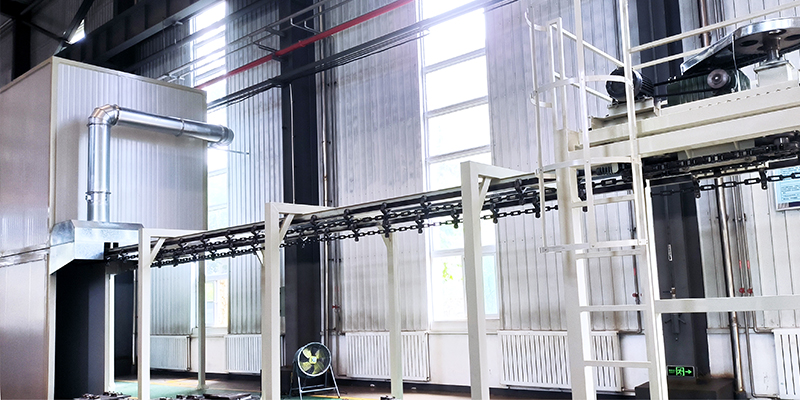
(Railway baseplate spraying line)
How to select the Automation Level
Before selecting an automation configuration, prepare information about:
- Current production volume
- Target production capacity
- Product dimensions and weight
- Product shapes and surface complexity
- Number of product types
- Powder colors and changeover frequency
- Required coating consistency
- Current labor requirements
- Available workshop space
- Expected production changes
This information allows the automation level to be matched to the actual production process.
The most practical powder coating line is not necessarily the one with the highest level of automation. It is the one where automation is applied to the operations that benefit from repeatability, while flexible manual work is retained where product variation makes it necessary.
FAQ: Does higher production volume always require a fully automatic powder coating line?
No. Production volume is only one factor. Product consistency, workpiece geometry, color-change frequency, labor requirements, and coating complexity also affect the decision. A factory with high production volume and standardized products may benefit from extensive automation, while a factory with many product types may use a combination of automatic spraying and manual operations.
FAQ: Can a powder coating line combine automatic and manual spraying?
Yes. A mixed system can use automatic guns for large or repeatable coating surfaces while operators handle difficult areas, touch-up work, loading, or unloading. This configuration can provide automation where it has a clear production benefit without requiring every operation to be automated.