Choosing between a powder coating reciprocator and a robotic spraying system is not simply a choice between two types of automatic equipment. Both can automate powder application, but they are designed around different production requirements.
For a new powder coating line or an automation upgrade, the decision should start with the workpieces and production process rather than the equipment itself.
Start With the Shape and Size of the Workpiece
Workpiece geometry is one of the first factors to consider.
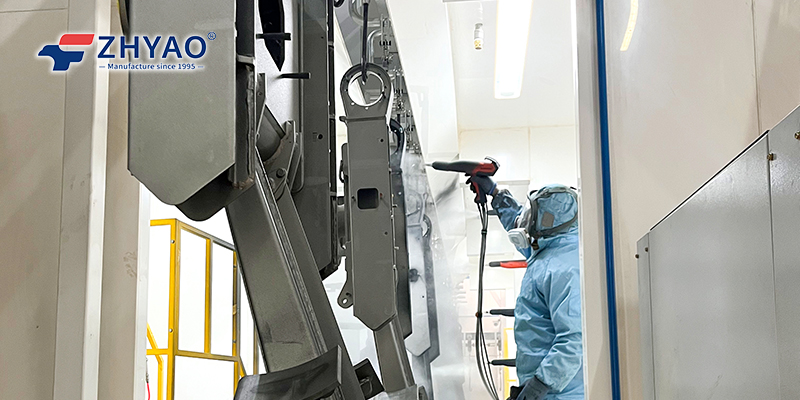
A reciprocator moves spray guns along a defined path, making it suitable for products with relatively consistent dimensions and repeatable shapes. When products have similar heights and widths, the spray movement can be planned around the production line.
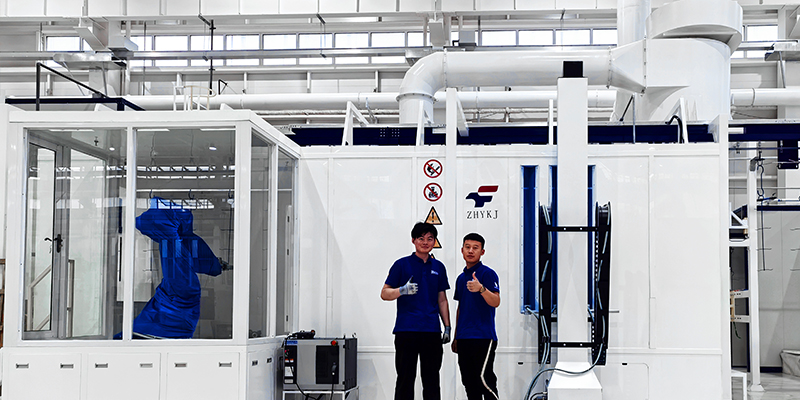
A robot works differently. Its multiple axes allow the spray gun to approach the workpiece from different directions and follow more complex paths.
This can be useful when products have irregular surfaces, different depths, complicated edges, or areas that require different spraying angles.
For example, a production line making standardized metal panels may have very different automation requirements from a line coating machine frames with several different geometries.
Consider How Much the Product Mix Changes
Product variety can significantly affect the equipment decision.
If a factory produces a limited range of products with relatively stable dimensions, a reciprocator can provide a practical automatic spraying solution. Its movement pattern can be configured around the normal production range.
If the product mix changes frequently, flexibility becomes more important.
A robot can store and switch between different spray programs, allowing the spraying path to change according to the workpiece. This can be useful when different products require different gun positions, angles, or movement patterns.
However, flexibility does not automatically mean that a robot is required. If product changes are mainly dimensional rather than geometrically complex, a reciprocator may still be suitable.
The key question is not simply “How many products do we make?” but “How different are these products from each other?”
Look at Required Coating Coverage
Automatic spraying equipment must provide adequate coverage, including surfaces that are not directly facing the spray guns.
For relatively uniform products, multiple guns mounted on a reciprocator can cover the required spraying area as the workpiece moves through the booth.
More complicated workpieces may require changes in spraying angle or gun position. A robot provides greater freedom of movement when the coating process requires access to different surfaces.
This is particularly relevant for products with deep structures, recessed areas, frames, brackets, or complicated three-dimensional surfaces.
At the same time, difficult coverage problems should not automatically be solved by adding a robot. Gun arrangement, workpiece orientation, hanger design, booth airflow, and powder characteristics can also affect coating results.
Production Speed and Line Capacity Matter
The required production rate should be considered together with workpiece dimensions and line layout.
A high-output line with standardized products may benefit from a repeatable reciprocator-based spraying arrangement. The equipment can work continuously with the conveyor system while workpieces pass through the spraying zone.
Robots can also provide high automation and repeatable spraying. However, the number of robots, their working envelope, spray gun configuration, and cycle time need to be evaluated against the actual production requirement.
Production capacity should therefore not be judged by equipment type alone.
A better approach is to calculate the required output from the actual workpiece cycle:
Required output → conveyor speed → workpiece spacing → spraying time → number and arrangement of automatic guns → automation configuration
This helps prevent a factory from selecting equipment based only on a nominal machine specification.
Consider the Required Flexibility
Flexibility is one of the important differences between the two approaches.
A reciprocator generally works around predefined movement parameters. This can be an advantage when production is stable because the spraying pattern can remain consistent.
Robotic systems offer more programmable movement. They can be configured for different workpiece geometries and spraying paths.
For factories expecting frequent product changes, new product development, or increasingly complex workpieces, this flexibility may have greater value.
For a factory producing the same type of workpiece for long periods, however, a highly flexible system may provide capabilities that are not fully used.
The equipment should therefore match the factory's actual production strategy.
Consider Hangers and Workpiece Orientation
The spraying system does not work independently from the conveyor and hanger system.
How a workpiece is positioned on the conveyor affects the distance between the product and spray guns, the surfaces exposed to the powder cloud, and the accessibility of difficult areas.
A product that is difficult to orient correctly may require a different spraying arrangement even if its dimensions appear suitable for automatic coating.
Automation planning should therefore consider:
- Workpiece dimensions
- Workpiece weight
- Hanger design
- Conveyor pitch
- Product orientation
- Distance between products
- Required spraying angles
- Booth dimensions
In some cases, changing the hanger or workpiece orientation can improve automatic coverage without significantly increasing the complexity of the spraying system.
Think About Future Production Changes
The decision should also consider where the factory expects production to go.
A line designed only around today's products may become restrictive if the factory later introduces larger parts, more product models, or more complicated geometries.
On the other hand, installing a more flexible robotic system does not necessarily make sense if production is expected to remain highly standardized.
The useful question is:
What level of flexibility does the factory actually need during the expected service life of the coating line?
This can help avoid both over-automation and under-automation.
Reciprocator and Robot Can Also Be Combined
The choice does not always have to be one or the other.
Some powder coating systems can use reciprocators for the main automatic spraying area while robots or manual operators handle products or surfaces requiring additional flexibility.
A mixed configuration can be considered when most products are standardized but a smaller proportion has complicated geometries.
For example, a factory may use automatic guns on reciprocators for the main surfaces and reserve additional spraying capacity for difficult areas or special product models.
The final configuration depends on product characteristics, production volume, coating requirements, and the desired level of automation.
What Should You Confirm Before Choosing?
Before asking a supplier to recommend a reciprocator or robot, prepare actual production information.
At minimum, the supplier should understand:
- Maximum and minimum workpiece dimensions
- Typical workpiece shapes
- Maximum workpiece weight
- Number of product models
- Production quantity per hour or shift
- Required coating surfaces
- Product loading orientation
- Available workshop space
- Expected future product changes
- Required level of manual and automatic operation
With this information, the spraying system can be designed around the production process instead of selecting equipment first and trying to adapt the line afterward.
The Decision Should Follow the Production Process
A reciprocator is generally associated with repeatable spraying movements and standardized production, while a robot provides greater freedom for more complex spraying paths and changing product geometries.
Neither equipment type should be selected simply because it offers a higher level of automation.
The more useful decision process is to start with the workpieces, production rhythm, coating coverage, product variety, and future requirements. These factors determine whether a reciprocator, robot, or combination of both fits the powder coating line.
For an automated powder coating system, the spraying equipment is only one part of the overall design. Conveyor movement, hanger configuration, booth layout, gun arrangement, powder recovery, and production capacity need to work together to achieve a stable process.
FAQ
Is a reciprocator suitable for high-volume powder coating production?
Yes. A reciprocator can be suitable for high-volume production when the workpieces have relatively consistent dimensions and spraying requirements. Its movement can be synchronized with the conveyor and automatic spray guns to provide repeatable coverage.
The actual capacity still depends on workpiece size, spacing, coating requirements, gun arrangement, and conveyor speed.
When is a robot more suitable for powder coating?
A robot can be considered when workpieces have complex three-dimensional geometries, multiple product models, or spraying paths that require different angles and positions. Its programmable multi-axis movement provides more flexibility than a fixed reciprocator path. However, the decision should be based on the actual coating process rather than product variety alone.