
Aluminum Profile Production Starts With the Right Line Layout
Aluminum profiles are widely used for windows and doors, curtain walls, furniture, solar structures, industrial frames, and other fabricated products.
Although the powder coating process is similar in principle to other metal products, aluminum profiles have their own requirements for surface preparation, hanging, spraying, curing, and handling.
A suitable aluminum profile powder coating line needs to match the profile dimensions, production volume, coating requirements, and factory layout. The design should be developed around the actual production process rather than simply selecting individual machines.
Workpiece Size Determines the Basic Line Structure
The first step is to determine the maximum and typical aluminum profile dimensions. Length is particularly important because aluminum profiles are often much longer than ordinary sheet-metal parts.
The profile length affects the conveyor arrangement, hanging method, spray booth dimensions, oven size, and factory space required for loading and unloading.
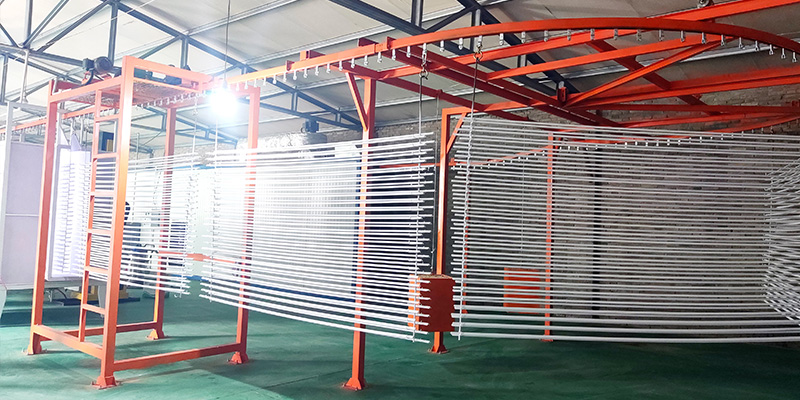
For long profiles, the hanging direction and distance between profiles need to be carefully considered. The profiles should remain stable during transportation and maintain sufficient clearance from neighboring workpieces and equipment.
Pretreatment Needs to Match Aluminum
Aluminum requires a pretreatment process suitable for its surface characteristics. Oil from extrusion, cutting, handling, or fabrication needs to be removed before powder coating.
A typical chemical pretreatment process may include degreasing, rinsing, surface conditioning or conversion treatment, followed by final rinsing and drying. The exact chemistry depends on the aluminum alloy, surface condition, coating system, and required corrosion performance.
The pretreatment section should therefore be designed together with the aluminum material and the selected coating specification.
Spray Pretreatment Works Well for Continuous Profiles
For continuous production of aluminum profiles, spray pretreatment can provide several treatment stages within a relatively compact production area.
Profiles pass through different spray zones while being transported by the conveyor. Nozzle arrangement, spray pressure, chemical circulation, and profile orientation all affect treatment coverage.
Long profiles also require attention to the ends and surfaces that may be partially shielded by the hanging arrangement. The pretreatment system should provide consistent contact with the surfaces that will later receive powder coating.
Drying Comes Before Powder Application
After pretreatment and rinsing, the aluminum profiles need to be properly dried before entering the powder coating area.
Moisture can remain around joints, profile cavities, grooves, or other areas depending on the profile design and hanging orientation.
The drying oven should therefore be sized according to the workpiece dimensions, conveyor speed, production output, and actual drying requirements.
A stable drying process provides a better starting condition for electrostatic powder spraying.
Hanging Design Has a Direct Effect on Coating Quality
Aluminum profiles are often long and relatively lightweight, making the hanging method particularly important.
The hanger needs to provide stable support without unnecessarily blocking the coating surface. The position of contact points should also be considered because powder cannot coat areas directly covered by the hanger.
For profiles with different cross-sections, a universal hanger may not always provide the same coating performance. In some production environments, interchangeable or product-specific hanging fixtures can be useful.
Spray Booth Design Depends on Profile Geometry
The spray booth needs enough working space for the longest and widest profiles that the line will process.
Automatic spray guns can be arranged on one or both sides of the profile depending on the required coating coverage. Reciprocators may move the guns vertically to cover different profile sections as the products pass through the booth.
For profiles with grooves, channels, or complicated cross-sections, gun angle and spraying distance become particularly important. Simply increasing the number of guns does not necessarily solve coverage problems.
Electrostatic Spraying Requires Good Grounding
Powder coating relies on electrostatic attraction between the charged powder particles and the grounded aluminum workpiece.
A stable grounding path is therefore important. Poor contact between the hanger and the profile can reduce powder transfer efficiency and make coating results less consistent.
Because aluminum profiles are frequently processed in long sections, the conveyor grounding system and hanger contact points should be checked as part of the overall spray line design.
Powder Recovery Matters When Colors Change
Aluminum profile production may involve several colors or powder specifications. When the production schedule changes frequently, powder recovery and booth cleaning become important parts of line operation.
A recovery system can collect overspray powder for suitable reuse or disposal according to the coating material and production requirements. The booth configuration should also allow practical cleaning between different colors.
The expected color-change frequency should be considered before selecting the powder booth and recovery system. A line producing one color continuously may require a different arrangement from a factory processing many colors in smaller batches.
Curing Oven Size Depends on More Than Profile Length
The curing oven must provide the required temperature and residence time for the selected powder coating.
For aluminum profiles, oven design needs to consider profile length, cross-section, wall thickness, loading density, conveyor speed, and powder manufacturer's curing requirements.
The important point is that the oven should be evaluated based on the actual workpiece temperature and curing requirements rather than simply the air temperature displayed by the oven control system.
Conveyor Speed Connects the Whole Process
The conveyor determines how quickly aluminum profiles move through pretreatment, drying, spraying, curing, and cooling.
If the required production output increases, the line may need a higher conveyor speed or greater production density.
However, increasing speed without checking pretreatment treatment time, spray coverage, drying, and curing residence time can create problems elsewhere in the process.
The conveyor speed should therefore be established as part of the complete process calculation.
Factory Layout Should Separate Key Process Areas
An aluminum profile powder coating line normally needs clearly defined areas for loading, pretreatment, drying, powder spraying, curing, cooling, and unloading.
The raw profile storage and finished-product handling areas should also allow enough space for movement and temporary storage.
When factory space is limited, the conveyor route can be designed with suitable turns or different line arrangements. The goal is to make effective use of available space without creating unnecessary handling or maintenance difficulties.
Production Capacity Should Be Calculated From Real Products
A production target such as “X tons per day” is useful, but it is not enough by itself to design the line.
The actual calculation should consider profile length, weight per meter, number of profiles per hanger, hanger pitch, conveyor speed, working hours, product mix, and expected utilization.
For example, two factories with the same daily tonnage may require different conveyor configurations if one produces long architectural profiles while the other processes shorter industrial profiles.
Different Automation Levels Can Be Used
Not every aluminum profile manufacturer needs the same degree of automation.
A manual or semi-automatic powder coating system may be suitable for smaller production volumes or frequent product changes.
Higher-volume production may benefit from automatic loading, automatic spray guns, reciprocators, automatic powder recovery, and an automatic conveyor system.
The appropriate automation level should be determined by production volume, labor availability, product variety, and the expected operating schedule.
Cooling and Unloading Should Not Be Overlooked
After curing, aluminum profiles need to cool sufficiently before further handling or packaging.
A cooling section gives the profiles time to reduce their temperature while remaining on the conveyor. The required cooling arrangement depends on the product, production speed, factory temperature, and handling method.
If profiles are removed from the line too quickly, operators may have difficulty handling them safely or may leave marks on the newly cured coating.
A Practical Aluminum Profile Line May Follow This Process
A typical automatic aluminum profile powder coating line can be arranged as:
Loading → Pretreatment → Drying → Powder Spraying → Powder Recovery → Curing → Cooling → Unloading
The exact configuration can change according to the aluminum alloy, surface preparation requirements, profile dimensions, production capacity, color-change frequency, and factory conditions.
Design the Line Around the Production Plan
A powder coating line for aluminum profiles should not be designed by looking at the spray booth or curing oven alone.
Profile dimensions determine the physical space. Pretreatment determines the surface condition. Hanging fixtures influence coating access. Conveyor pitch and speed determine production density.
The spray booth determines powder application conditions, while the curing oven must provide the required thermal process.
When these factors are calculated together, the resulting line is more likely to match the actual production requirements.
Frequently Asked Questions
- What pretreatment is commonly used for aluminum profiles before powder coating?
Aluminum profiles commonly use chemical pretreatment designed for aluminum substrates, which may include degreasing, rinsing, surface conditioning or conversion treatment, final rinsing, and drying. The exact process depends on the alloy and coating requirements.
- What information is needed to design an aluminum profile powder coating line?
Important information includes profile length and cross-section, material, weight, daily production target, working hours, coating type and colors, pretreatment requirements, factory dimensions, and the desired level of automation.