
Key Factors for Selecting a Curing Oven That Matches Your Powder Coating Process
Start With the Powder and Workpiece
A powder curing oven should be selected according to the powder manufacturer's curing requirements and the characteristics of the workpieces.
Different powder formulations can have different curing schedules. At the same time, thick steel parts, thin sheet metal, and aluminum components heat up at different rates.
The oven therefore needs to be designed around the actual production conditions rather than temperature alone.
Check the Workpiece Dimensions
The largest workpiece determines the useful oven dimensions. Measure the maximum length, width, and height of the products, including the space required for hanging and movement.
The oven should provide enough clearance around the workpieces for proper hot-air circulation and convenient maintenance access.
Calculate the Required Heating Time
Curing is based on the temperature and time required by the powder coating, but the workpiece temperature is what matters for curing.
A heavy steel component may require more time to reach the target metal temperature than a thin aluminum part. Conveyor speed and oven length therefore need to be considered together.
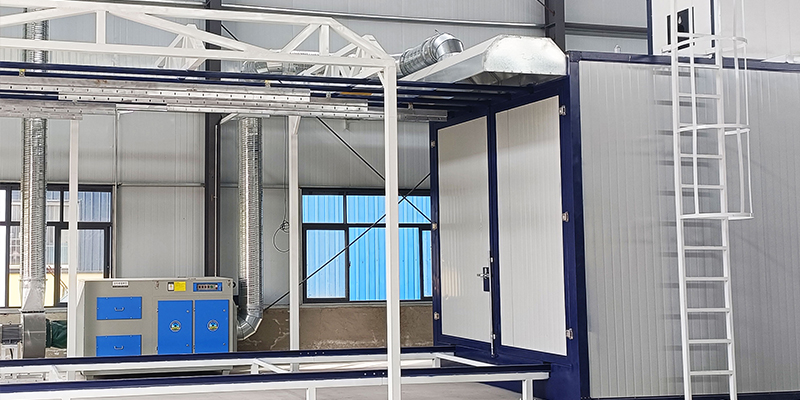
(Henan Shenhuo Group Spraying Line Project – Curing Oven)
Look at the Heating Method
Powder curing ovens may use gas, electricity, or other heating arrangements depending on the project.
The appropriate choice depends on local energy availability, operating costs, required temperature, production schedule, and factory conditions. The heating system should provide stable temperature control rather than simply reaching a high maximum temperature.
Pay Attention to Air Circulation
Uniform hot-air circulation is important because different areas of the oven should provide reasonably consistent heating conditions.
Poor circulation can create temperature differences inside the oven, which may result in under-cured or overexposed areas. Oven design should therefore consider air ducts, circulation fans, air distribution, and the position of the workpieces.
Insulation Affects Operating Costs
Good insulation reduces heat loss through the oven walls and doors.
The external surface temperature should also be controlled to maintain a safer working environment and reduce unnecessary heat release into the workshop. Door construction, panel joints, insulation material, and sealing all contribute to the oven's thermal performance.
Match the Oven to Conveyor Speed
For a conveyorized powder coating line, oven length and conveyor speed determine how long the workpiece remains inside the curing zone.
If production output increases and conveyor speed is raised, the available curing time decreases. The oven therefore needs sufficient effective heating length to maintain the required curing conditions at the planned production rate.
Consider Different Production Modes
Some factories run one product continuously, while others process several product types with different thermal characteristics.
If production varies significantly, oven zoning and temperature control can provide additional process flexibility. However, the configuration should still follow the actual powder specifications and workpiece requirements.
Think About Loading and Unloading
The oven entrance and exit should work smoothly with the conveyor and surrounding production areas.
Adequate clearance helps prevent workpieces from touching oven walls or each other during transportation. The layout should also leave practical space for inspection and maintenance.
Maintenance Should Not Be an Afterthought
Fans, burners, heating elements, temperature sensors, ducts, and control components all require periodic inspection.
The oven should provide reasonable access to these components so that routine maintenance does not require unnecessary dismantling or extended production downtime.
Conclusion
Choosing a powder curing oven requires more than selecting a temperature rating. Powder curing requirements, workpiece material and size, heating time, heating method, air circulation, insulation, conveyor speed, production variation, and maintenance access all need to be considered.
A properly matched oven should provide stable and repeatable curing conditions while fitting naturally into the overall powder coating line.
FAQ
What temperature should a powder curing oven use?
The correct curing temperature and time depend on the powder coating manufacturer's specifications and the actual workpiece temperature. The oven should be designed to achieve those conditions consistently.
Does a larger curing oven always provide better curing?
No. Oven size alone does not guarantee proper curing. Heating capacity, airflow, temperature uniformity, workpiece loading, and residence time are equally important.
SEO Title
How to Choose a Powder Curing Oven for a Coating Line
SEO Keywords
powder curing oven, powder coating curing oven, curing oven for powder coating, powder coating oven, industrial curing oven, powder coating equipment
SEO Description
Learn how to choose a powder curing oven based on powder curing requirements, workpiece size, heating time, airflow, insulation, conveyor speed, production needs, and maintenance access.