
In an industrial powder coating line, the conveyor system is one of the core structures that connects all process stages. It transports workpieces through pretreatment, drying, powder spraying, curing, cooling, and unloading areas while maintaining stable production rhythm and process synchronization.
In many coating projects, production instability is not caused by spray guns or ovens, but by unreasonable conveyor system design. Conveyor speed fluctuation, excessive workpiece swinging, improper hanger spacing, and insufficient load capacity can all affect coating quality and production efficiency.
Therefore, conveyor system planning should be considered as a system-level engineering task during powder coating line design.
The Role of Conveyor Systems in Powder Coating Lines
The conveyor system determines how workpieces move through the production process. It directly influences:
Production capacity
Process timing
Spray coating consistency
Oven curing time
Automation coordination
Maintenance efficiency
A stable conveyor structure helps maintain consistent movement speed and workpiece positioning, which is especially important for automatic spray systems and robotic coating applications.
Common Conveyor Types Used in Powder Coating Lines
Different production requirements require different conveyor structures.
Overhead Conveyor System
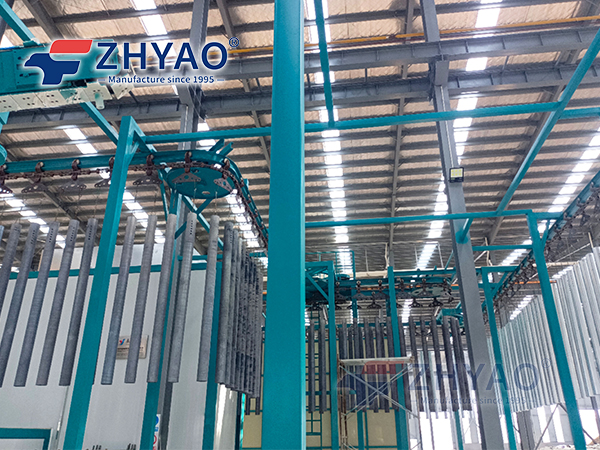
Overhead conveyor systems are widely used in powder coating lines because they save floor space and support continuous production flow.
They are commonly applied in:
Metal furniture coating
Automotive parts coating
Hardware product coating
Electrical cabinet production
This structure is suitable for medium and large-scale production environments.
Power and Free Conveyor System
Power and free conveyor systems allow flexible movement and accumulation of workpieces.
Compared with standard conveyor systems, they provide:
Better production buffering
Flexible loading and unloading
Independent movement control
Easier integration with automated stations
This type is often used in coating lines with multiple process branches or variable production schedules.
Ground Track Conveyor System
Ground conveyor systems are usually applied for heavy workpieces or large steel structures.
They provide strong load capacity and simplified maintenance access, but require more factory floor space.
Conveyor Speed and Process Synchronization
Conveyor speed is directly related to process timing inside the powder coating line.
For example:
Pretreatment requires sufficient cleaning and chemical reaction time
Spray booths require stable movement for uniform powder application
Curing ovens require controlled residence time for proper powder curing
If conveyor speed is too fast, coating thickness and curing quality may become unstable. If speed is too slow, production efficiency decreases and energy consumption increases.
Therefore, variable frequency drive systems are commonly used to adjust conveyor speed according to production requirements.
Conveyor Layout Planning
Conveyor routing should be planned together with the entire coating line layout.
Several engineering factors should be considered:
Material Flow Direction
The conveyor path should remain as smooth and direct as possible to reduce unnecessary turning points.
Turning Radius
Sharp turns may cause workpiece swinging, especially for long or lightweight products.
Maintenance Accessibility
Enough maintenance space should be reserved around conveyor tracks, drives, and lubrication points.
Separation Between Process Zones
Wet pretreatment areas should be separated from powder spraying and curing sections to reduce contamination risks.
Future Expansion
In some projects, conveyor structures are designed with reserved space for future production upgrades.
Conveyor Design Inside the Spray Booth
Inside the spray booth, conveyor stability becomes particularly important.
The conveyor system must provide:
Stable speed
Low vibration
Accurate hanger positioning
Continuous grounding connection
Poor grounding between the workpiece and conveyor chain can reduce electrostatic powder transfer efficiency and affect coating uniformity.
For automatic reciprocator systems or robot spraying systems, synchronization accuracy between conveyor movement and spray motion is also critical.
High-Temperature Conveyor Design for Curing Ovens
The curing oven section operates under high-temperature conditions for long periods.
Conveyor systems inside the oven should consider:
Chain thermal expansion
Heat-resistant bearings
High-temperature lubrication
Conveyor tension stability
Thermal insulation for drive components
If thermal expansion is not properly considered, conveyor chains may deviate or become unstable during long-term operation.
Common Conveyor System Problems
Several conveyor-related problems are frequently found in powder coating projects:
Conveyor speed does not match curing requirements
Excessive conveyor turning points cause workpiece swinging
Poor hanger grounding affects powder adhesion
Conveyor load estimation is inaccurate
Maintenance access space is insufficient
Lubrication planning is ignored
These issues can influence long-term production stability and increase maintenance frequency.
Conclusion
The conveyor system is not simply a transport structure inside a powder coating line. It directly affects process coordination, coating consistency, production rhythm, and equipment reliability.
A properly designed conveyor system should balance load capacity, movement stability, process timing, maintenance accessibility, and future production flexibility.
In industrial powder coating engineering, conveyor planning should be integrated into the overall system design stage rather than treated as an independent component selection task.