For manufacturers planning to upgrade surface finishing capacity, one of the most common questions is: How much does an automatic powder coating systemcost?
The answer depends on several factors, including production capacity, workpiece size, automation level, pretreatment process, curing system configuration, and powder recovery requirements. Different industries and production targets require different line structures, so the final investment can vary significantly.
In this article, we break down the key factors that influence the cost of an automatic powder coating system and explain what manufacturers should consider before making an investment decision.
Looking for a suitable automatic powder coating solution for your factory? Contact us for a customized proposal based on your production requirements.
Production Capacity Has the Largest Impact on Cost
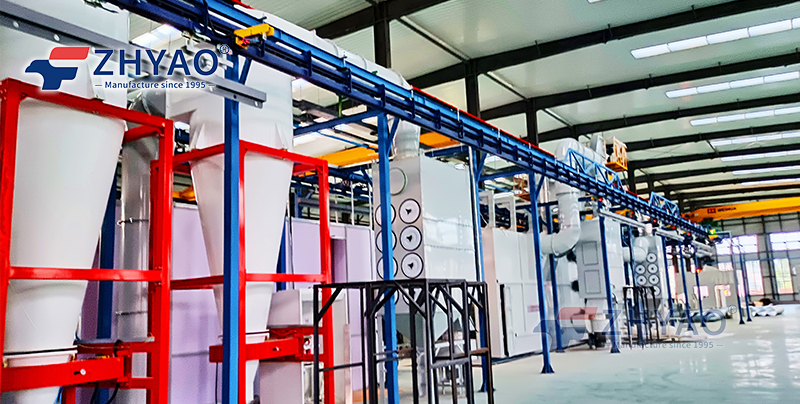
Production capacity is one of the biggest factors affecting system pricing. A compact powder coating line for small batch production requires fewer spray guns, shorter conveyor systems, and smaller curing ovens, while high-capacity automated lines require larger equipment and more complex automation systems.
For example:
Small and medium production lines are commonly used for metal furniture, hardware parts, and appliance accessories.
Large automated systems are typically used for aluminum profiles, steel structures, automotive parts, and continuous industrial production.
As production speed increases, the conveyor system, spray booth size, powder recovery system, and oven dimensions also become larger, directly affecting total equipment cost.
Automation Level Influences Overall Investment
Automatic powder coating systems are available in different automation levels, including semi-automatic, fully automatic, and robotic spraying systems.
A basic automatic system may include:
Automatic spray guns
Conveyor system
Standard curing oven
Manual loading and unloading
A higher-level automated system may additionally include:
Robotic spraying systems
Automatic reciprocators
Automatic color change systems
Intelligent PLC control systems
Production monitoring systems
Higher automation reduces labor dependency and improves production consistency, but it also increases the initial equipment investment.
Pretreatment System Configuration Matters
Pretreatment is a critical process in powder coating because it directly affects coating adhesion and corrosion resistance.
Different pretreatment methods have different costs:
Manual pretreatment tanks are suitable for smaller production volumes.
Automatic spray pretreatment systems are commonly used in continuous industrial production.
Multi-stage pretreatment systems require more tanks, pumps, heating systems, and water treatment equipment.
If products are used in outdoor environments or require higher corrosion resistance, manufacturers often choose more advanced pretreatment processes, which increases the overall project cost.
Powder Recovery System Affects Long-Term Operating Costs
Many manufacturers focus only on the initial equipment price while overlooking long-term powder consumption costs.
A high-efficiency powder recovery system can significantly improve powder utilization and reduce material waste during production.
Common recovery systems include:
Single-stage cartridge recovery systems
Cyclone + secondary filter recovery systems
Fast color change recovery systems
Although advanced recovery systems require higher initial investment, they can help reduce long-term operating expenses, especially in large-scale production environments.
Curing Oven Design Also Changes Pricing
The curing oven is one of the largest energy-consuming sections in a powder coating line.
Several factors affect oven cost:
Oven size
Heating method
Insulation structure
Temperature control system
Conveyor design
Common heating options include:
Natural gas heating
Electric heating
Infrared heating
For high-capacity industrial lines, energy-efficient oven design becomes increasingly important because it directly affects long-term production costs.

Factory Layout and Product Dimensions Are Important
The dimensions and shape of the workpieces strongly influence line design.
Large products require:
Wider spray booths
Larger ovens
Stronger conveyor systems
More installation space
Complex-shaped products may also require additional spray guns or robotic spraying paths to ensure uniform coating coverage.
Because every factory layout is different, most automatic powder coating systems are customized rather than standardized equipment.
Is a Fully Automatic Powder Coating System Worth the Investment?
For manufacturers with stable production demand, automatic powder coating systems can provide several long-term advantages:
More stable coating quality
Higher production efficiency
Reduced labor dependency
Better powder utilization
Improved production consistency
Although the initial investment is higher than manual systems, automated lines often provide better production stability and lower operating costs over time.
Conclusion
The cost of an automatic powder coating system depends on production capacity, automation level, pretreatment configuration, powder recovery efficiency, oven design, and factory layout requirements.
Instead of focusing only on the initial equipment price, manufacturers should evaluate long-term production efficiency, energy consumption, powder utilization, and maintenance requirements when selecting a powder coating solution.
A properly designed automatic powder coating system can help improve coating quality, production stability, and operational efficiency for long-term manufacturing growth.
Contact us today to discuss your production requirements and get a customized automatic powder coating system solution.