
Introduction
For many first-time buyers, selecting a powder coating line is not simply a matter of comparing equipment specifications. In automated powder coating system projects, most operational issues come from system imbalance rather than individual machine performance.
A powder coating line should always be evaluated as a complete production system, where pretreatment, coating, curing, and conveying are interdependent and must be technically synchronized.
This guide presents a system engineering approach to help beginners understand how to plan an automated powder coating system with stable output and scalable capacity.
1. Application-Driven System Design
Different industries require different system logic. The configuration of an automated powder coating system is directly influenced by the workpiece type and production environment.
Typical application scenarios include:
Metal furniture production (frame structures, mixed shapes)
Automotive components (high precision and thermal stability demand)
Aluminum profiles (continuous extrusion coating lines)
Steel structural parts (heavy-duty pretreatment requirements)
Each scenario defines different requirements for pretreatment intensity, curing stability, and conveyor configuration.
2. Powder Coating Line as a Linked System
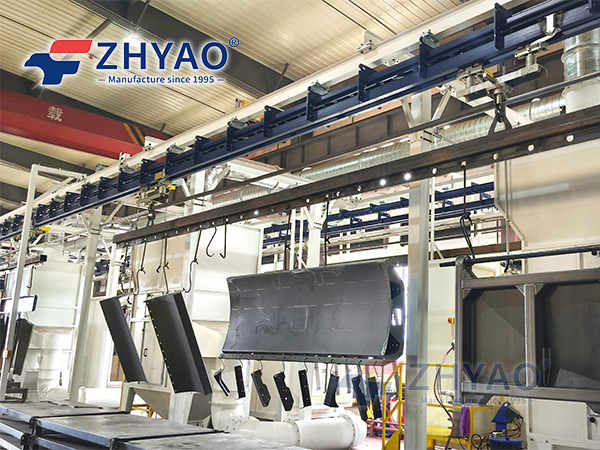
A powder coating line is not a collection of machines but a synchronized production chain.
System interaction can be simplified as:
Pretreatment determines surface readiness
Spray booth determines coating uniformity
Curing oven determines film formation stability
Conveyor system determines production rhythm
If any stage is mismatched, the entire automated powder coating system loses stability.
3. Key Engineering Principle: System Balance Rule
A stable powder coating line must follow a fundamental engineering principle:
No process stage should exceed the capacity of the slowest stage in the system.
In real production environments, line instability is usually caused by:
Oversized spraying capacity with insufficient curing time
Fast conveyor speed without thermal balance
Pretreatment delay not aligned with production rhythm
System design must prioritize balance over individual performance.
4. Critical Design Parameters Before Equipment Selection
Before selecting any equipment, system engineers typically evaluate three core variables:
4.1 Workpiece Geometry Factor
Complex geometries require improved airflow distribution and electrostatic field control in the spray booth.
4.2 Thermal Load Factor
Thermal mass determines curing time, oven length, and temperature recovery speed.
4.3 Surface Contamination Level
Oil, rust, or oxide layers determine whether spray pretreatment or immersion pretreatment is required.
These parameters define system architecture before equipment selection begins.
5. Equipment Configuration Logic in Automated Powder Coating Systems
5.1 Pretreatment System Selection
Spray pretreatment is typically used for standardized continuous production, while immersion systems are applied in heavy contamination or complex geometry cases.
The decision is based on process stability rather than investment cost.
5.2 Powder Spray Booth Performance
Spray booth performance depends on airflow balance and particle recovery consistency rather than equipment power alone.
Poor airflow design often leads to uneven coating thickness even under correct spraying conditions.
5.3 Curing Oven Engineering
The curing oven is the most critical thermal stability component in a powder coating line.
A properly designed oven must ensure:
Consistent temperature distribution across all zones
Stable thermal recovery during continuous operation
Correct dwell time matching conveyor speed
Undersized ovens are one of the most common causes of production instability.
5.4 Conveyor System Synchronization
The conveyor system defines the operational rhythm of the entire automated powder coating system.
If speed, loading intervals, and curing time are not synchronized, issues such as under-curing, overheating, or bottlenecks will occur.
6. Engineering Case Study
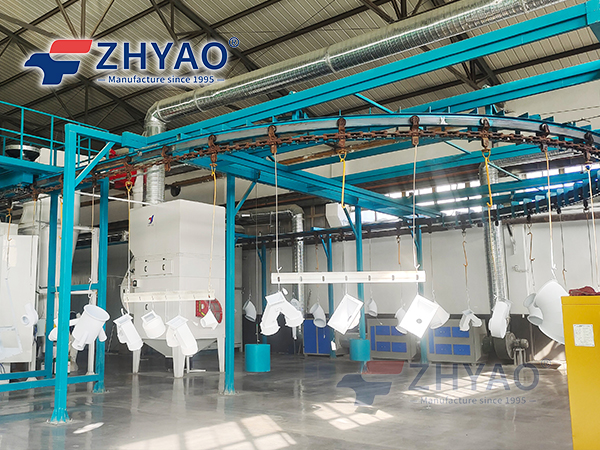
A metal component manufacturer upgrading from batch coating to a continuous automated powder coating system experienced inconsistent coating thickness and curing variation.
The issue was not related to individual equipment failure, but system mismatch.
Engineering optimization included:
Adjusting pretreatment dwell time to stabilize cleaning performance
Extending curing oven length to improve thermal balance
Synchronizing conveyor speed with curing curve requirements
Redesigning spray booth airflow for uniform particle distribution
After system integration, production stability improved and rework rates were significantly reduced.
7. Common System Planning Mistakes
Most beginners encounter similar engineering errors:
Selecting equipment based on price instead of system compatibility
Ignoring thermal balance in oven design
Overestimating achievable line speed
Underestimating layout constraints in factory design
Treating automation as an optional upgrade instead of system foundation
In automated powder coating systems, system logic always overrides individual machine specifications.
Conclusion
A powder coating line should always be evaluated as an integrated engineering system rather than a list of equipment. For beginners, understanding system synchronization between pretreatment, spraying, curing, and conveying is the key to stable production.
A well-designed automated powder coating system reduces operational uncertainty and provides a scalable foundation for long-term industrial production.
For new projects, an early-stage engineering layout review is often more valuable than equipment comparison alone, especially in capacity planning and energy efficiency control.