
The Conveyor Is the Backbone of the Coating Line
In a conveyorized powder coating system, the conveyor determines how workpieces move from loading through pretreatment, drying, powder spraying, curing, cooling, and unloading.
Choosing a conveyor is therefore not simply a matter of selecting a transport device. Its load capacity, speed, carrier spacing, route, and layout need to match the complete coating process.
Start With Workpiece Weight and Dimensions
The first information to establish is the size and weight of the workpieces.
Heavy components require carriers and conveyor structures with sufficient load capacity. Long or large products may need wider spacing between hangers to prevent contact during transportation.
Workpiece shape also affects how products should be hung. A suitable hanger should keep the part stable while allowing pretreatment chemicals, powder, and curing heat to reach the required surfaces.
Calculate the Required Conveyor Speed
Conveyor speed should be connected to the required production output and process time.
A faster conveyor can increase the number of workpieces passing through the line, but only if pretreatment, drying, powder spraying, and curing can support the same pace.
For example, increasing conveyor speed without allowing sufficient curing time can affect the final coating performance. The conveyor should therefore be designed as part of the complete process rather than calculated separately.
Choose the Right Conveyor Structure
Different production conditions may call for different conveyor arrangements.
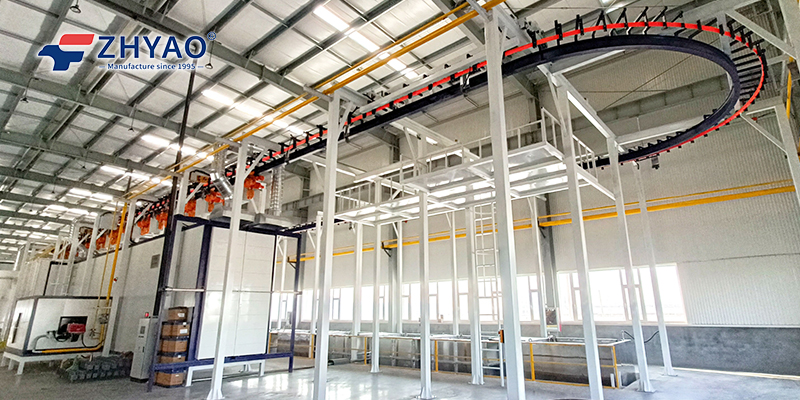
An overhead conveyor is widely used in industrial powder coating lines because it keeps workpieces suspended and allows the floor area to remain available for other operations.
An accumulation conveyor adds buffer sections where workpieces can temporarily queue. This can be useful when different process stages have varying cycle times or when production flow needs additional flexibility.
The appropriate structure depends on the product and factory layout.
Consider the Hanger Design
Hangers directly affect how many products can be carried and how effectively they can be coated.
The hanger should match the workpiece geometry, weight, and required orientation. Poor positioning can create shadow areas during powder spraying or affect how the product receives heat inside the curing oven.
For manufacturers handling several product types, interchangeable or product-specific hanger designs may be considered.
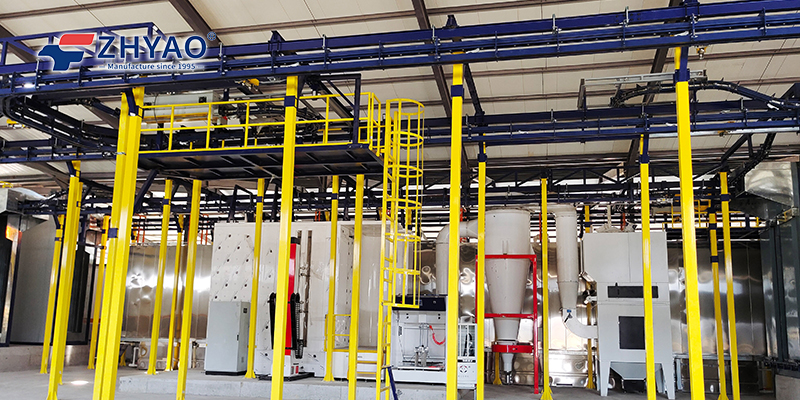
(ZHYAO Algeria Accumulating Conveyor Project)
Factory Layout Affects Conveyor Selection
The available building length, width, and height should be checked before finalizing the conveyor route.
Columns, doors, production areas, loading points, unloading points, ovens, and maintenance access can all influence the conveyor path. In an existing factory, the conveyor often needs to be designed around structures that cannot easily be moved.
Think About Production Flexibility
Manufacturers should also consider whether production will remain stable or change over time.
If product sizes, output, or production batches vary significantly, a conveyor with appropriate buffer capacity and adjustable production control may provide greater flexibility.
For stable production with similar products, a simpler conveyor arrangement may be sufficient.
Maintenance Should Be Part of the Design
Conveyor chains, bearings, drive units, carriers, and other mechanical components require regular inspection and maintenance.
The system should provide practical access to key components. Lubrication points, inspection areas, emergency stops, and replacement procedures should be considered during design rather than after installation.
Conclusion: select the Conveyor as Part of the Whole Line
The right conveyor system depends on workpiece weight, dimensions, hanger design, production output, conveyor speed, process time, factory layout, and future production requirements.
An overhead conveyor may suit many industrial applications, while an accumulation configuration can provide additional flexibility where production flow varies.
The important point is to design the conveyor together with pretreatment, ovens, powder spraying, and the overall material flow.
FAQ
How do I determine the right conveyor speed for a powder coating line?
Conveyor speed should be calculated from required production output, hanger spacing, workpieces per carrier, pretreatment time, drying requirements, and curing time.
What information is needed to select a powder coating conveyor?
Key information includes workpiece dimensions, weight, shape, production volume, hanger method, factory dimensions, process sequence, and whether accumulation or future production flexibility is required.