
Manual Spraying Can Work Well at the Beginning
Manual powder spraying is often a practical way to start coating production. It allows operators to handle different product shapes, small batches, and frequent changes without requiring a complex automated setup.
The question is not whether manual spraying is good or bad. The more useful question is whether it still matches the factory's current production pattern.
Production Volume Is Increasing
One of the clearest signs for considering automatic spraying is a sustained increase in output.
When operators spend most of the shift repeatedly spraying similar workpieces, automatic spray guns and reciprocators can take over consistent spraying movements. This can allow the existing workforce to focus on loading, inspection, adjustments, and other production tasks.
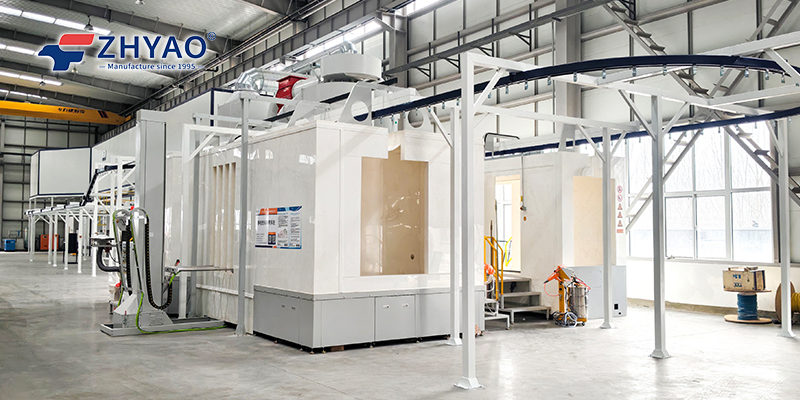
(ZHYAO Shandong CNC Machine Tool Powder Coating Line Project)
Operators Are Spending Too Much Time on Repetitive Work
Manual spraying requires operators to maintain spray distance, gun movement, overlap, and coverage throughout the production run.
For repetitive products, this can become tiring and may make maintaining consistent spraying conditions more difficult over long shifts. Automation can provide programmed and repeatable movement for suitable workpiece surfaces.
Coating Quality Varies Between Operators
Different operators may have different spraying habits. Changes in gun distance, angle, movement speed, and overlap can affect powder deposition.
If coating results vary noticeably between shifts or operators, it may be worth evaluating whether automatic spraying can handle the more repetitive parts of the process.
Automation does not remove the need for process control, but it can reduce variation caused by repetitive manual movement.
The Products Are Consistent Enough
Automatic spraying is easier to apply when workpieces have predictable dimensions and repeatable hanging positions.
If every product has a different shape, size, or coating requirement, manual spraying may still provide useful flexibility. In mixed production, a combination of automatic and manual guns can be more practical than fully automatic spraying.
Labor Availability Is Becoming a Constraint
A factory may reach a point where adding more manual spraying operators is no longer an attractive way to increase output.
Before increasing staffing, manufacturers can compare the cost of additional labor with the investment required for automatic spray equipment, reciprocators, powder feeding, and related modifications.
The comparison should be based on actual production conditions rather than equipment price alone.

Color Changes Are Not the Main Problem
Frequent color changes do not automatically mean that automatic spraying is unsuitable. The important factor is how the powder booth, guns, recovery system, and cleaning process are configured.
For factories producing long batches of the same color, automatic spraying can be easier to utilize continuously. For frequent changes, equipment designed for efficient cleaning and powder switching becomes more important.
Your Existing Booth Can Support Automation
Before upgrading, check whether the current powder coating booth has sufficient working width, height, airflow, and clearance for automatic guns and reciprocators.
The conveyor, hanger spacing, powder recovery system, electrical controls, and compressed-air supply should also be checked. Sometimes the spray equipment can be upgraded without replacing the complete powder coating line, but compatibility needs to be confirmed first.
Look at the Economics Over Time
The decision should not be based only on how much automatic equipment costs. Consider the current labor requirement, production output, coating consistency, maintenance, powder consumption, and expected operating period.
If manual spraying is becoming a production bottleneck, automation may make economic sense even when the initial investment is higher.
Conclusion: Upgrade When the Process Has Outgrown Manual Spraying
Moving from manual powder coating to automatic spraying makes sense when production becomes repetitive, output increases, operator workload rises, or coating consistency becomes difficult to maintain.
The best time to upgrade is not determined by a fixed production number. It is when the existing manual process starts limiting the factory's efficiency or future production plans.
For many manufacturers, a hybrid powder coating system can be a sensible transition: automatic spraying handles repeatable areas, while manual guns remain available for complex surfaces and product variations.
FAQ
What production volume requires automatic powder spraying?
There is no universal production threshold. The decision depends on workpiece consistency, spraying time, labor requirements, output targets, and the expected return on the investment.
Can I add automatic spraying to my existing powder coating line?
In many cases, yes. The booth, conveyor, powder recovery, electrical system, compressed air, and workpiece arrangement should be checked to determine whether the existing line can support the upgrade.