
A well-planned powder coating line layout is one of the most important factors affecting production efficiency, coating quality, material flow, and future expansion. Whether building a new powder coating facility or upgrading an existing production line, proper layout design can help reduce unnecessary handling, improve workflow efficiency, and support stable long-term operation.
This guide explains the key considerations involved in powder coating line layout design and how manufacturers can develop a practical coating system that matches their production requirements.
Why Layout Design Matters in a Powder Coating Line
Many manufacturers focus on equipment selection while overlooking the impact of production line layout.
In practice, an inefficient layout can lead to:
Excessive material handling
Production bottlenecks
Unnecessary labor movement
Limited expansion capability
Reduced overall productivity
A properly designed layout helps coordinate all process stages, allowing products to move efficiently through pretreatment, coating, curing, cooling, inspection, and packaging.
Understand Product Characteristics First
Before determining the layout, manufacturers should evaluate the characteristics of the products to be coated.
Important factors include:
Product dimensions
Product weight
Annual production volume
Production batch size
Surface quality requirements
Future product development plans
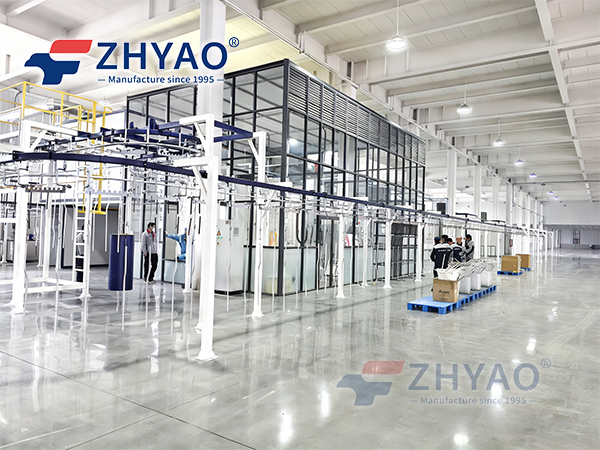
For example, long aluminum profiles require different conveyor and booth arrangements than small hardware components.
The layout should always be based on actual production requirements rather than a standard template.
Plan the Production Flow Carefully
An effective powder coating line follows a logical process sequence.
A typical layout includes:
Loading Area → Pretreatment → Drying Oven → Powder Coating Booth → Curing Oven → Cooling Area → Inspection → Unloading
The goal is to maintain smooth product movement while minimizing cross-traffic and unnecessary transportation.
Straight-line layouts are commonly used when sufficient factory space is available, while U-shaped or L-shaped layouts may be considered when floor space is limited.
Consider Conveyor System Selection
The conveyor system directly influences layout design.
Common options include:
Overhead Conveyor Systems
Suitable for continuous production and medium-to-high production volumes.
Advantages include:
Efficient material handling
Reduced floor space usage
Continuous workflow
Accumulation Conveyor Systems
Suitable for facilities requiring buffering between production stages.
These systems allow products to be temporarily stored without interrupting line operation.
Floor-Mounted Conveyors
Often used for heavy products or specialized manufacturing processes.
The conveyor type should match both product characteristics and production objectives.
Allocate Adequate Space for Pretreatment
Pretreatment is a critical stage that directly affects coating adhesion and durability.
When planning pretreatment areas, consider:
Tank length or spray chamber dimensions
Maintenance access
Chemical storage requirements
Water treatment systems
Safety clearances
Insufficient space in the pretreatment area can create operational and maintenance challenges later.
Optimize Powder Coating Booth Position
The powder coating booth should be positioned to support efficient workflow and maintenance access.
Design considerations include:
Operator access
Powder recovery system location
Color change requirements
Airflow management
Future equipment upgrades
Adequate surrounding space simplifies cleaning and routine maintenance activities.
Leave Room for Oven Maintenance and Air Circulation
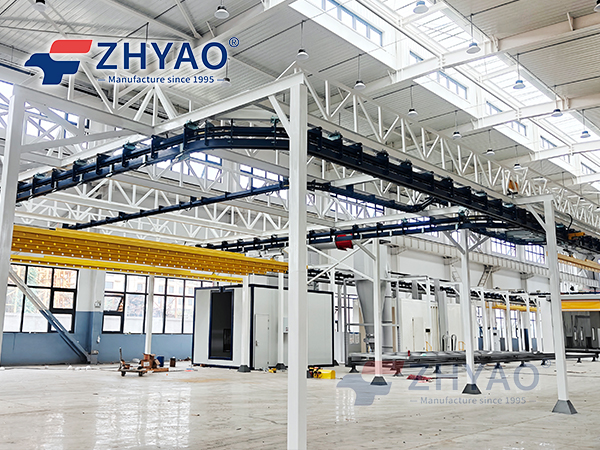
Curing ovens occupy a significant portion of the production line.
Layout planning should account for:
Maintenance access
Burner or heating equipment servicing
Air circulation requirements
Conveyor entry and exit clearance
Safety distances
Proper oven placement contributes to stable curing performance and easier maintenance.
Plan for Future Expansion
Many manufacturers initially design lines based on current production demand only.
However, future growth may require:
Additional spray guns
Larger curing ovens
Extra pretreatment capacity
Additional conveyor sections
Automated loading and unloading systems
Leaving space for future upgrades can reduce modification costs later.
Safety and Environmental Considerations
Layout design should also address operational safety and environmental requirements.
Key considerations include:
Ventilation systems
Emergency access routes
Fire protection systems
Dust collection systems
Maintenance walkways
A safe and organized production environment supports long-term operational reliability.
Conclusion
A successful powder coating line layout is not simply about arranging equipment inside a factory. It requires careful consideration of product characteristics, production flow, conveyor selection, maintenance access, and future expansion plans.
By designing the layout around actual manufacturing requirements, companies can improve workflow efficiency, support stable coating quality, and create a production system that remains adaptable as business needs evolve.
If you are planning a new powder coating project or upgrading an existing facility, evaluating the layout at the early design stage can help avoid operational challenges in the future.