Selecting the right powder coating equipment is not only about budget or factory size. The most important factor is the product itself. Different materials, shapes, sizes, and production volumes require different coating configurations.
Understanding how product characteristics influence equipment selection helps manufacturers avoid costly mismatches and long-term inefficiencies.
1. Small Hardware Parts: Focus on Uniformity and Efficiency
Small hardware components such as brackets, fasteners, hinges, and fittings are typically produced in high volumes.
Key considerations:
High production capacity
Consistent coating thickness
Efficient powder recovery
Stable conveyor speed
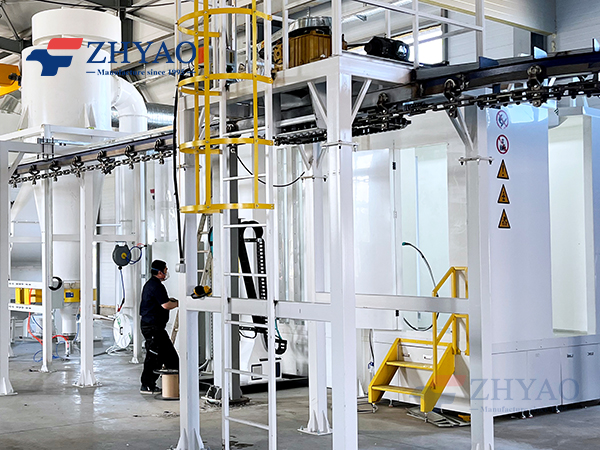
For this type of product, an automated powder coating line with a continuous conveyor system and cyclone recovery unit is often suitable. Automated spray guns improve uniformity, especially for repetitive parts, while efficient powder recycling reduces material waste.
2. Aluminum Profiles: Emphasis on Surface Quality and Length Handling
Aluminum profiles used in construction or industrial applications often require smooth finishes and strict appearance standards.
Key considerations:
Long workpiece handling capability
Precise thickness control
Stable curing temperature
Anti-contamination management
Horizontal powder coating lines with optimized airflow and temperature control systems are commonly used for aluminum profiles. Proper oven design ensures consistent curing across long sections.
3. Fire Fighting Pipes: Internal and External Coating Requirements
Fire protection pipelines often require corrosion resistance and uniform coating inside and outside the pipe surface.
Key considerations:
Rotational spraying systems
Adequate pre-treatment
Strong adhesion performance
Compliance with coating thickness standards
For pipes, specialized coating systems with pipe rotation mechanisms improve uniformity. Integrated pre-treatment processes such as shot blasting or chemical cleaning are essential for adhesion and durability.
4. Steel Structures and Large Fabrications: Handling Size and Weight
Large steel structures, frames, and heavy components present challenges in transportation and curing.
Key considerations:
Load-bearing conveyor systems
Large curing ovens
Flexible spray gun positioning
Adequate workspace clearance
In these cases, heavy-duty overhead conveyor systems and spacious spray booths are required. Automation helps maintain consistent coating thickness across complex geometries.
5. Security Mesh and Wire Products: Coverage of Complex Intersections
Wire mesh and security panels have multiple intersections and edges, which can create coating blind spots.
Key considerations:
Strong electrostatic penetration
Adjustable spray angles
Optimized airflow circulation
Fine powder control
Automated systems with programmable spray paths help improve coverage in dense mesh structures and reduce uneven coating.
6. Low-Volume or Custom Products: Flexibility Matters
If production involves frequent product changes, small batches, or custom designs, flexibility may be more important than full automation.
Semi-automatic powder coating equipment or modular line configurations allow manufacturers to balance efficiency with adaptability.
Matching Equipment to Product Strategy
Choosing powder coating equipment should start with analyzing:
Product dimensions and weight
Production volume and batch size
Surface quality requirements
Market standards (domestic or export)
Long-term growth plans
The best solution is not necessarily the largest or most automated system, but the one that aligns with product characteristics and production strategy.
Careful evaluation at the planning stage prevents operational inefficiencies and ensures sustainable production performance.