
Introduction
Electrostatic powder coating lines are widely used in modern industrial surface finishing, especially for metal parts that require consistent coating quality and stable production processes. Compared with conventional liquid painting or standalone coating equipment, powder coating lines emphasize process continuity, repeatability, and controlled operating conditions, making them suitable for medium- to large-scale manufacturing.
Key Advantages of Electrostatic Powder Coating Lines
1. Stable and Continuous Process Operation
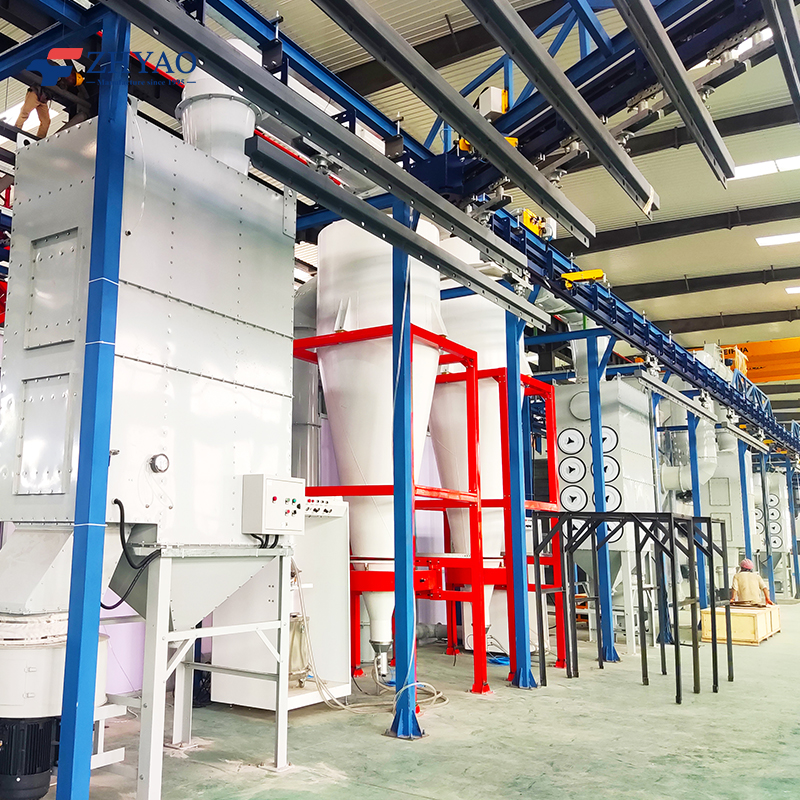
A typical electrostatic powder coating line integrates pre-treatment, powder application, curing, and cooling through a continuous conveying system.
When process parameters are properly matched, each stage operates under stable conditions, reducing variations caused by manual intervention. This stability is particularly important for products with consistent appearance and quality requirements.
2. Consistent Coating Thickness Control
Electrostatic attraction allows powder particles to deposit evenly on grounded metal workpieces under controlled voltage and current settings.
By adjusting spray distance, gun parameters, and movement paths, coating thickness can be maintained within a predictable range, helping reduce uneven coverage and rework in daily production.
3. Predictable Material Utilization
Powder coating lines are usually equipped with enclosed spray booths and recovery systems. Oversprayed powder that does not adhere to the workpiece can be collected and reused according to process requirements.
This process structure allows manufacturers to better evaluate powder consumption and maintain a controlled coating environment without relying on assumptions beyond system design.
4. High Automation Level and Process Repeatability
Electrostatic powder coating lines can be configured with automatic spray guns, reciprocators, and centralized control systems.
For standardized products, automated operation helps maintain consistent coating results over long production cycles and reduces dependence on individual operator experience, improving overall process repeatability.
5. Flexible Integration for Different Production Needs
Powder coating lines can be adapted to different product sizes, shapes, and production volumes through adjustable parameters and modular equipment design.
This flexibility allows manufacturers to adjust coating processes or introduce new products without fundamental changes to the entire line structure.
Typical Application Industries
Electrostatic powder coating lines are applied across multiple industries where metal surface protection and appearance consistency are required, including:
Electrical and power distribution equipment
Such as control cabinets, enclosures, and electrical boxes requiring durable and uniform coatings
Construction and architectural hardware
Including metal profiles, railings, and structural components exposed to outdoor environments.
Machinery and industrial components
Used for frames, covers, and protective parts where coating durability and adhesion are important.
Transportation and public infrastructure
Suitable for standardized metal parts produced in consistent batches.
Each industry has different requirements for coating thickness, line speed, and equipment configuration, making proper process matching essential.
Conclusion
The value of an electrostatic powder coating line lies not in individual equipment speed, but in overall process stability, coating consistency, and long-term operational reliability.
For manufacturers with stable product structures and continuous production plans, powder coating lines provide a controlled and repeatable surface finishing solution that supports consistent quality and efficient production management.