
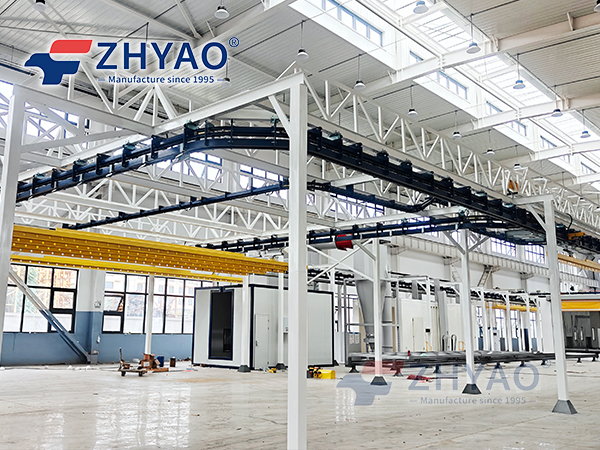
Powder coating systems are widely applied in industrial surface finishing where durability, coating consistency, and material utilization are important considerations. A complete system is typically composed of pretreatment equipment, drying sections, powder spray booths, conveying units, curing ovens, and powder recovery devices. The coordination between these components plays a significant role in achieving stable production performance.
In practical applications, system configuration is often influenced by product geometry, required coating thickness, and daily production targets. For example, long structural parts or heavy metal components may require overhead conveyor layouts to support continuous movement through each coating stage. Meanwhile, smaller batch production environments may benefit from compact system designs that simplify operation and reduce space constraints. Careful airflow design in spray booths and balanced line speed control can help improve powder deposition efficiency and coating uniformity.
Automation level is another variable that manufacturers evaluate when planning powder coating systems. Manual spraying stations remain relevant in flexible production settings, while automatic reciprocators or robotic spraying units are considered in high-volume operations. Consistent temperature management in curing ovens, along with appropriate dwell time, contributes to coating performance and surface appearance.
From an operational perspective, long-term reliability depends on routine maintenance access, component wear resistance, and adaptability to future process changes. Modular structural concepts allow sections of the powder coating system to be upgraded or expanded without significant disruption. By aligning system design with real production needs and environmental conditions, manufacturers can support stable coating quality and predictable workflow efficiency.