
How Different Coating Processes Affect Industrial Spray Painting Quality
Introduction
Selecting the right coating process is a critical decision in industrial manufacturing. Among the most commonly used technologies, wet paint spraying and powder coating each offer distinct advantages and limitations.
The choice between these two processes directly affects coating appearance, durability, production efficiency, and long-term operating cost.
This article provides a technical comparison of wet paint and powder coating to help manufacturers make informed decisions based on application requirements rather than assumptions.
Process Overview: Wet Paint and Powder Coating
Wet Paint Spray Coating
Wet paint coating involves applying liquid paint using spray guns, followed by solvent evaporation or thermal curing. This process is widely used for products requiring:
Specific color shades or surface finishes
Thin and smooth coating layers
Flexibility for small-batch or customized production
Wet paint systems can adapt to complex designs and color changes but require careful control of ventilation, drying conditions, and waste handling.
Powder Coating
Powder coating applies dry powder particles electrostatically to the workpiece surface, followed by curing in an oven to form a solid film. It is commonly selected for:
Metal parts requiring durable and thick coatings
High-volume and repetitive production
Applications demanding strong corrosion resistance
Powder coating systems generally offer higher material utilization and more stable coating thickness compared to wet paint.
Coating Quality and Surface Performance
Coating quality is influenced not only by equipment but also by the intrinsic characteristics of each process.
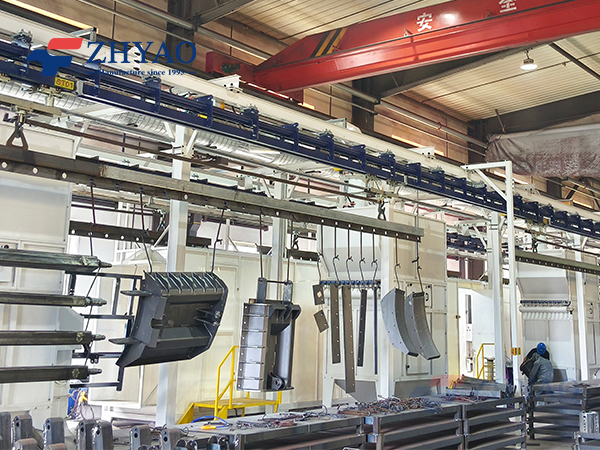
Wet paint coatings are suitable for achieving smooth surfaces and fine visual effects. However, maintaining uniform thickness on complex geometries can be challenging, particularly in manual or semi-automatic applications.
Powder coating provides more consistent film thickness and edge coverage, making it effective for structural components. Surface finish options may be more limited compared to wet paint, depending on powder formulation.
Production Efficiency and Process Stability
From a production standpoint, powder coating often supports higher throughput due to its continuous operation and reduced drying time once the curing process is optimized.
Wet paint lines may require longer drying or flash-off periods, especially when solvent-based coatings are used. This can impact line speed and space requirements within the facility.
Automatic spray painting lines help improve stability for both processes by controlling spray parameters, conveyor speed, and curing conditions, reducing variability caused by manual operation.
Material Utilization and Environmental Considerations
Material efficiency is another key factor in process selection.
Powder coating typically achieves higher transfer efficiency, as overspray can often be collected and reused. Wet paint processes usually generate more waste due to overspray and solvent evaporation, requiring additional treatment systems.
Environmental compliance requirements vary by region and coating type, making proper system design essential regardless of the chosen process.
Choosing the Right Process for Your Application
There is no universal coating solution suitable for all products. Manufacturers should consider:
Product geometry and material
Appearance and performance requirements
Production volume and batch size
Facility layout and regulatory conditions
In many cases, manufacturers operate both wet paint and powder coating lines to address different product categories within the same plant.
Conclusion
Wet paint and powder coating each play an important role in modern industrial spray painting. Understanding their technical differences allows manufacturers to align coating performance with production goals more effectively.
Rather than focusing on which process is “better,” the key lies in selecting the coating technology that best matches product requirements, quality standards, and long-term operational planning.